
A hotel schedules a vendor briefing as an ordinary meeting, and every guest who joins can unmute and share as if they were panelists. Which change gives guests an attendee experience instead?
Select an answer to reveal the explanation.
Short Explanation
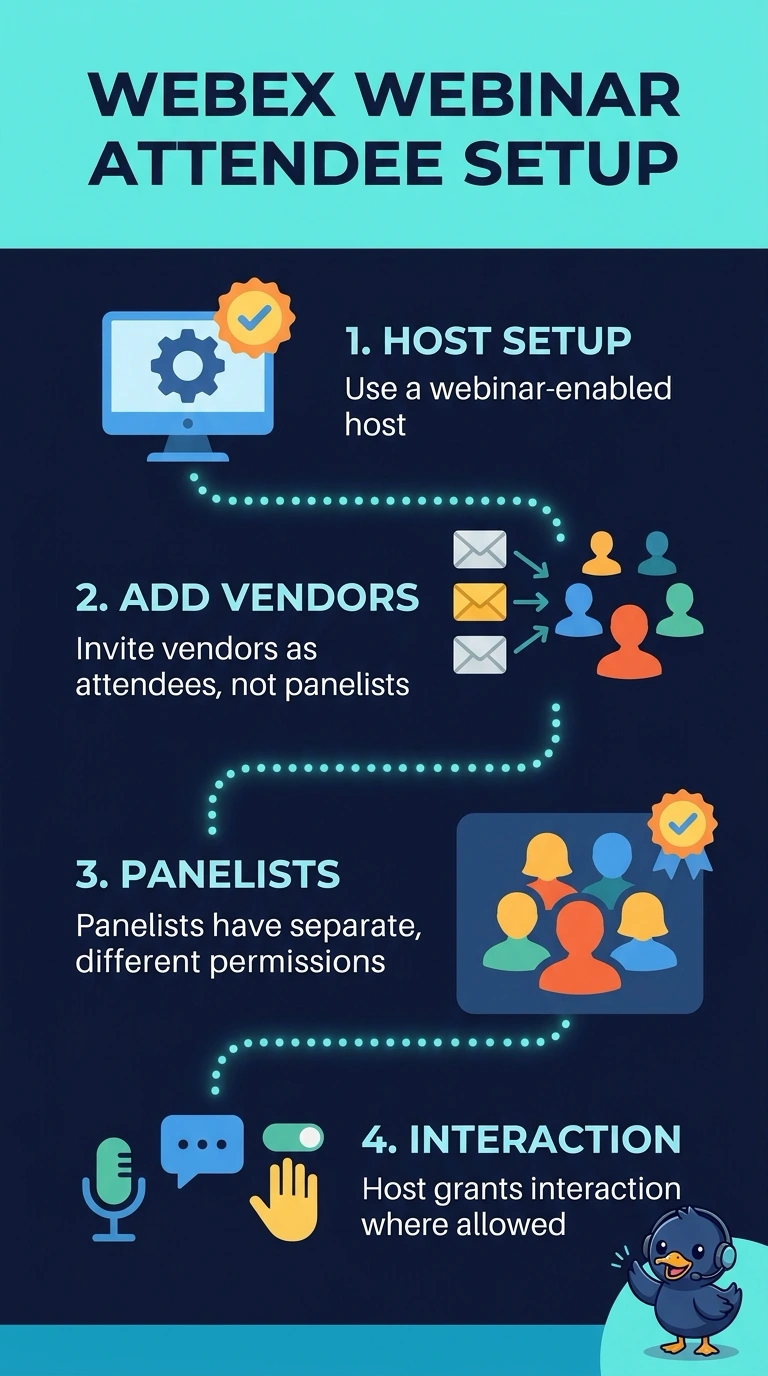
You’ve set up the briefing as an ordinary meeting, so guests can join with meeting-style privileges. Choose a Webex Webinar with a webinar-enabled host and invite vendors as attendees; a PSTN trunk, site survivability, or a dial-plan change won’t assign attendee roles.
Full Explanation
The briefing was scheduled as an ordinary meeting, so guests join with that meeting’s privileges rather than webinar attendee permissions. Attendee and panelist permissions are distinct, and the host can grant interaction where the webinar configuration allows it. Schedule a Webex Webinar with a webinar-enabled host and invite vendors as attendees rather than panelists; this is the option that provides the attendee experience. Adding a PSTN trunk to the hotel calling location does not assign meeting roles: a trunk provides a calling path, not a way to determine attendee or panelist status. Turning on site survivability for the ballroom phones does not rewrite an ordinary meeting as a webinar; site survivability provides basic backup calling when the cloud path fails. Changing the hotel dial plan does not demote a panelist-style participant, because a translation pattern rewrites digits on a call rather than changing how a guest joins a meeting. Exam caveat: Meeting roles are controlled by the session type and its configuration, not by the hotel’s call routing. Practical check: Schedule a test session as a webinar, join as a guest, and confirm the guest cannot share or unmute with panelist-style privileges while the hotel dial plan remains unchanged.