
An organization dial plan routes an airline’s local on-premises extension range toward the wrong gateway. Which routing choice should the matching dial plan use?
Select an answer to reveal the explanation.
Short Explanation
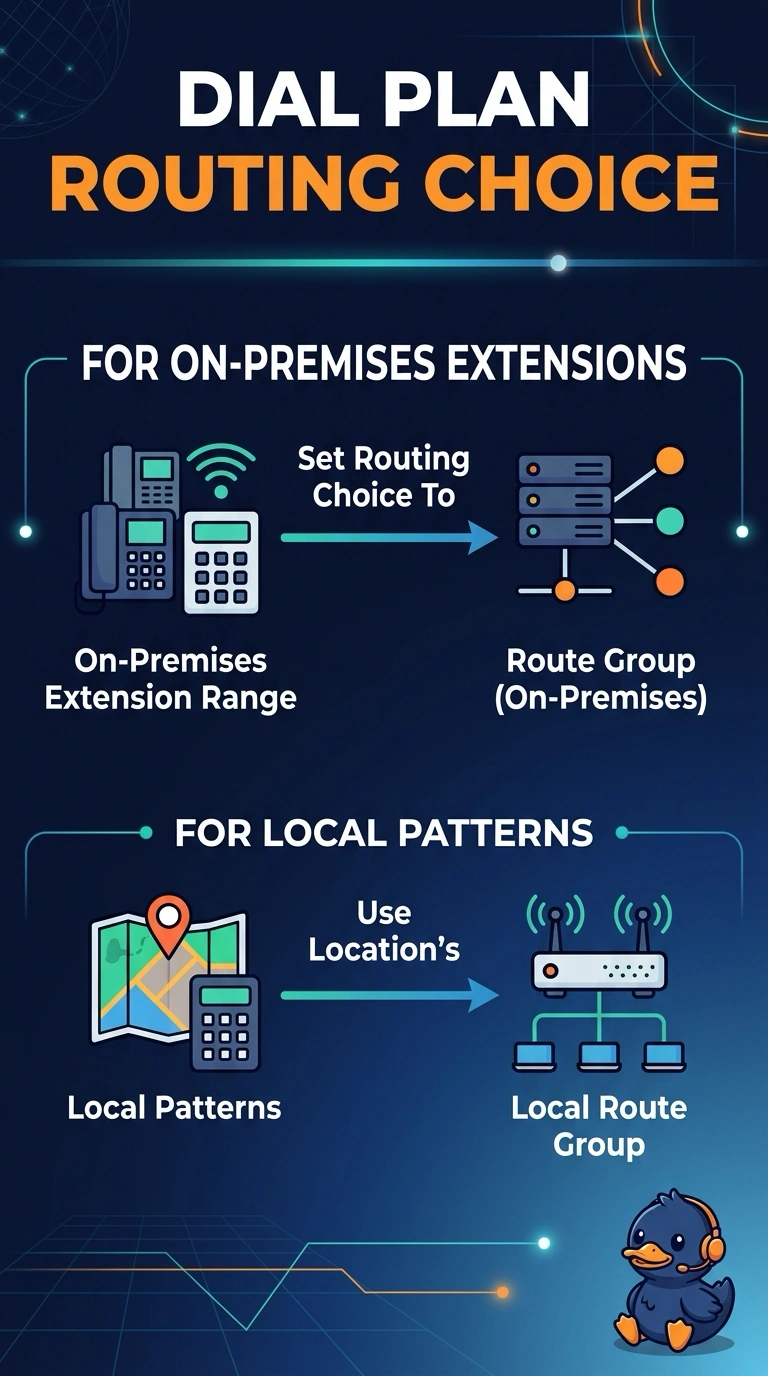
You have a global dial plan pointing an airline’s on-premises range at the wrong gateway. You fix it by setting that dial plan’s Routing Choice to the route group that reaches the on-premises range. Adding capacity on the wrong exit only sends more calls the wrong way.
Full Explanation
In Webex Calling, dial plans are global and each matching dial plan has one Routing Choice that determines where calls to that pattern go. When a dial plan for an airline’s local on-premises extension range points toward the wrong gateway, the correction is to set that dial plan’s Routing Choice to the route group that reaches the on-premises extension range, so matching calls leave through trunks that can deliver that range. Adding more trunks inside the international route group adds capacity on an exit that is already wrong and does not change the dial plan’s destination, so those calls would still go to the wrong gateway. A call permission that blocks international dialing controls a different call type and does not retarget the matching dial plan, so it leaves the misrouted range still pointing at the wrong route group. A translation pattern that deletes digits rewrites the called number and does not pick the route group, because number manipulation and route selection are different steps. Exam caveat: a route group is an ordered set of trunks for capacity and failover, and it takes effect for a pattern only when the dial plan’s Routing Choice selects it. Operational check: place a test call to the on-premises range and confirm it uses the intended route group.