
At a school district, a translation rewrites a blocked international number into digits that look local, and the call is then allowed. Permissions are supposed to stop that international call type. Which policy and digit-rewrite changes reliably preserve the international block?
Select an answer to reveal the explanation.
Short Explanation
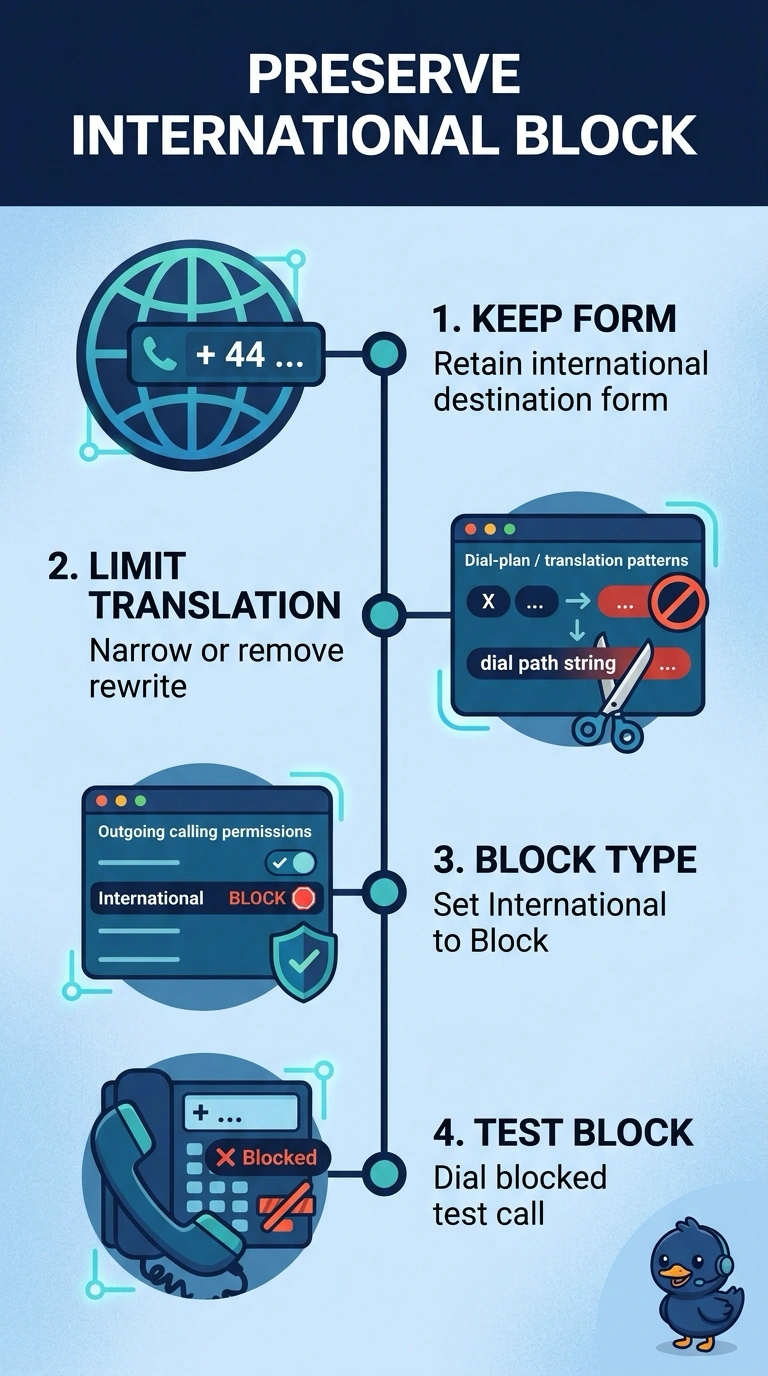
You keep that international number looking international so your block can see it. Remove or narrow the sneaky translation and set International to Block, and you reliably stop the bypass.
Full Explanation
Remove or narrow the translation so the destination retains its international form, and set International to Block in the applicable outgoing calling permissions. Translation patterns for outbound calls rewrite digits, while outgoing calling permissions separately allow or block call types such as International, so the two must not work against each other. When a broad translation turns a blocked international destination into digits that look local, the permission check can no longer see the true international form and the block is bypassed. Narrowing or removing that translation preserves the international identity, and an explicit Block for International then reliably stops it. Adding a trunk because a failed call looks like a dead route confuses routing capacity with policy; a reachable but prohibited destination is a permission issue, and extra capacity does not restore the type check. Stripping still more digits from the rewritten local pattern only rewrites the disguise further into a shorter code and does nothing to expose the original international type to permissions. Moving the caller into another calling location changes site numbers and local identity, but a location name does not substitute for an International Block.