
A laboratory trunk to the local gateway is up and registered, yet it carries no calls. No dial plan sends matching calls to the route group that contains that trunk. What should be pointed at that route group?
Select an answer to reveal the explanation.
Short Explanation
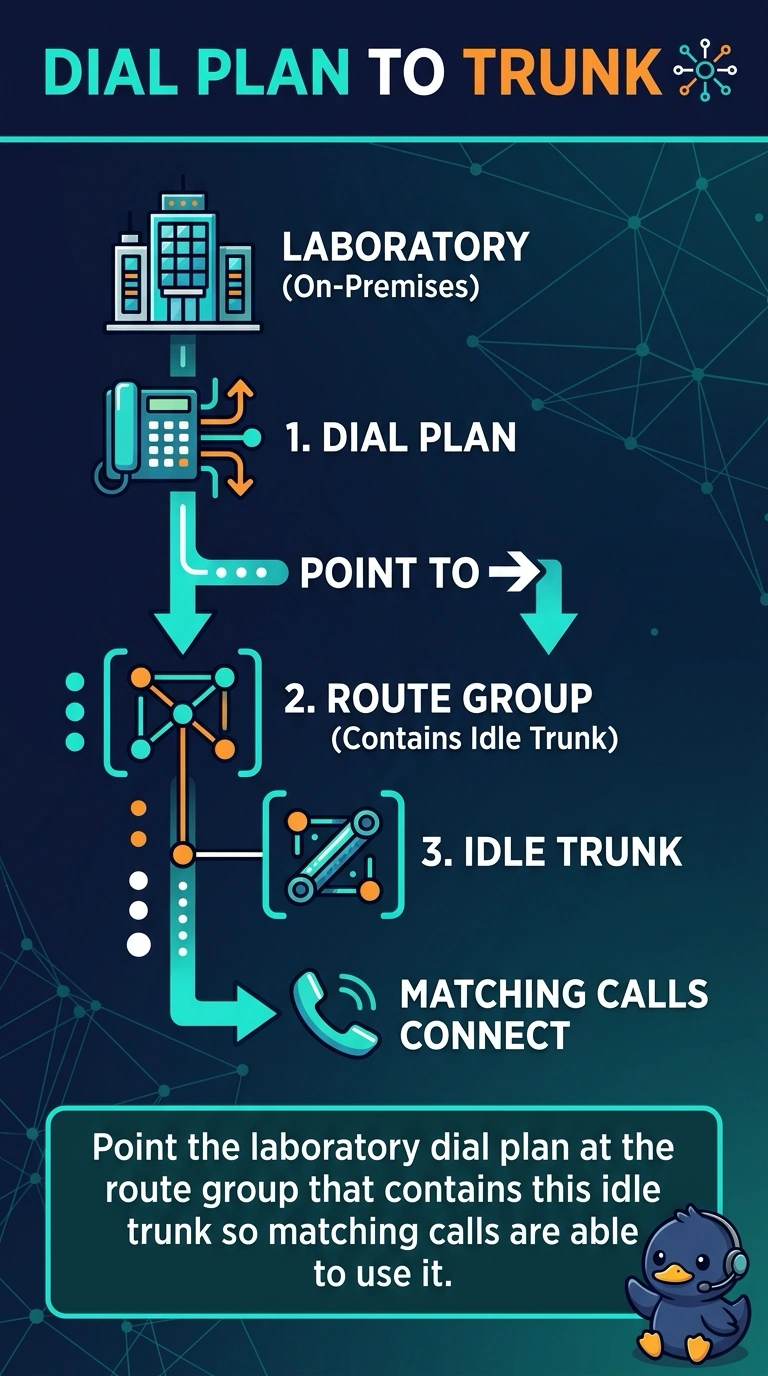
An on-ramp that no map points to stays empty even when the pavement is perfect. You point the organization dial plan for the laboratory’s on-premises destinations at the route group that contains this idle trunk. Rebooting the trunk, adding a translation on it, or widening call permissions does not send calls there.
Full Explanation
Point the organization dial plan for the laboratory’s on-premises destinations at the route group that contains this idle trunk so matching calls are able to use it. A matched destination pattern sends the call to the route group selected by that dial plan. Reboot the registered trunk, because an idle trunk that is already up must be forced through registration a second time. The trunk is already up, so another registration attempt does not create a dial-plan path toward its route group. Add a translation directly on the trunk so a digit rewrite begins attracting calls that no dial plan is currently sending. A translation rewrites digits and does not choose the route group, so it cannot attract calls that no dial plan sends. Allow internal call permissions and expect those permissions to select the route group that holds the idle trunk. Call permissions allow or block a call type, and they do not select which route group a dial plan uses. Exam caveat: A trunk can be healthy and still carry nothing when no dial plan points at its route group, and a route group does not change call permissions. Operational check: Point a test pattern at that route group, place a matching call, and confirm it uses the trunk that was idle.