
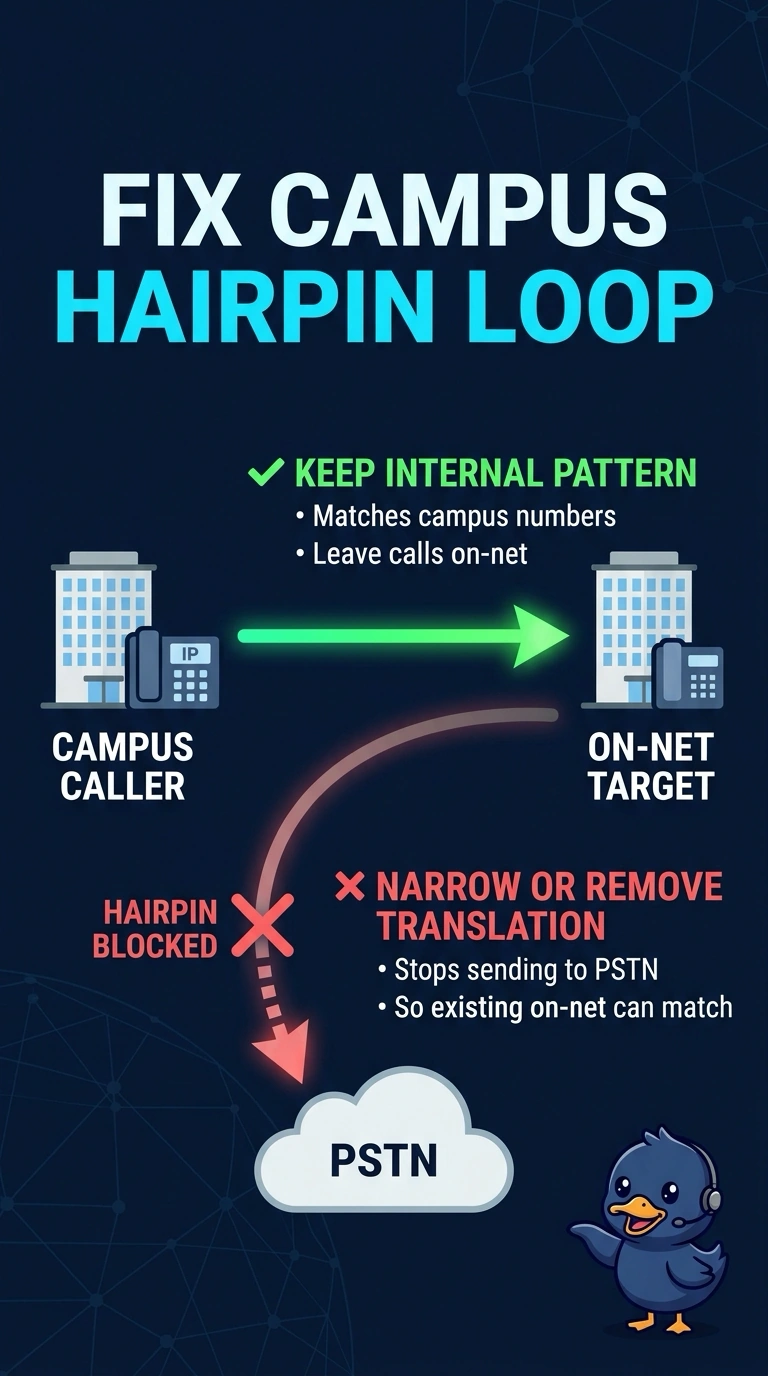
Calls between two campuses of a hospital are rewritten into public-network format, sent out a trunk, and delivered back into the other campus. The campuses can already reach each other internally. What should match those campus numbers?
Select an answer to reveal the explanation.
Short Explanation
You can keep these calls on-net by narrowing or removing the translation that sends the campus numbers to the PSTN, letting the existing on-net destination match. Adding a second PSTN trunk, blocking international calling, or registering phones to the Survivability Gateway during normal cloud service does not stop the hairpin; translation is the key.
Full Explanation
Narrow or remove the translation that sends these campus numbers to the PSTN so the existing on-net destination can match. Webex Calling can translate digits before routing; adding an on-net pattern alone does not necessarily bypass a translation that already matches, so narrow or remove the translation to let the on-net route match. Adding a second PSTN trunk gives the hairpin between campuses more capacity, but it does not stop a translation from forcing internal calls onto the public network. Blocking international calling prevents an international call type, but these campus calls are internal calls being rewritten into public-network format. Registering campus phones to the Survivability Gateway during normal cloud service is not how everyday on-net calls avoid the trunk; survivability registration is a fallback when the cloud path fails. Exam caveat: A translation that works for outside calls can strip or reshape digits another location still needs, so narrow its scope. Practical check: Place a campus-to-campus test call and confirm it stays on-net rather than leaving on the PSTN trunk and returning.