
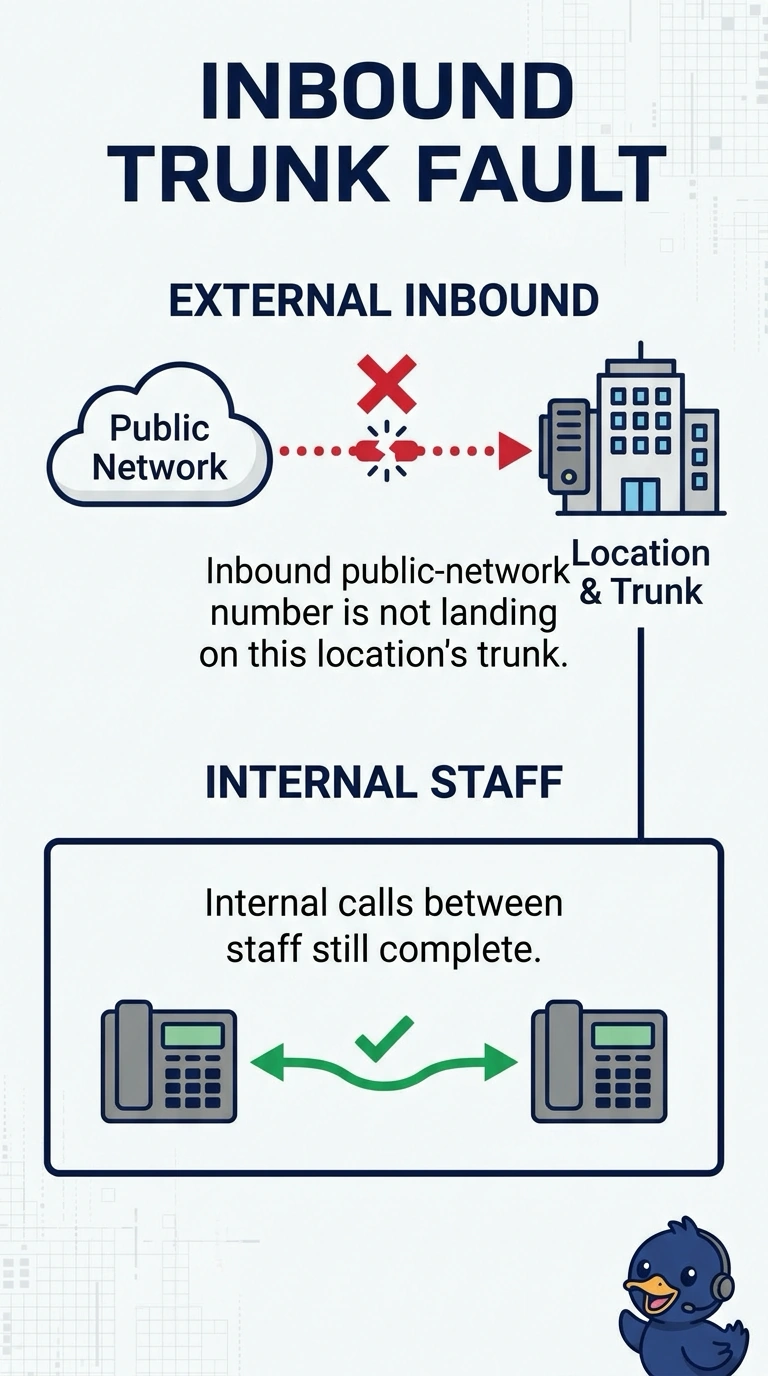
A hospital cardiology desk can place internal calls between staff, but inbound calls from the public network do not ring the published main number. This location uses premises-based PSTN, and the carrier trace shows the published DID is not delivered to its intended gateway. Which fault matches that split?
Select an answer to reveal the explanation.
Short Explanation
The front bell can be wired to the wrong door while the inside phones still call each other. You land the inbound public-network number on this location's trunk, because staff can already call one another. The trap is blaming registration or a meeting recording for a call that does not reach the desk.
Full Explanation
Internal calls prove the cardiology phones are registered and can reach one another. Inbound public-network calls are a separate reachability problem: the published number has to land on this location's trunk. The inbound public-network number is not landing on this location's trunk, while internal calls between staff still complete, which matches the split. Saying the cardiology phones are unregistered, so neither an inbound public-network call nor an internal call can complete until registration returns, contradicts the working internal calls. Blaming a meeting recording control on the hospital meetings site for dropping inbound calls to the published cardiology number applies a meeting control to a calling path that does not enter a meeting. Treating a call permission on the cardiology users as the block on inbound public-network calls, while internal calls remain allowed, misreads permissions: permissions allow or block a call type the user dials, and they do not decide which trunk presents an inbound number to the location. Working internal calls establish the internal path; trace inbound delivery and the DID assignment separately. In operations, place an inbound call to the published number and confirm it arrives on this location's trunk.