
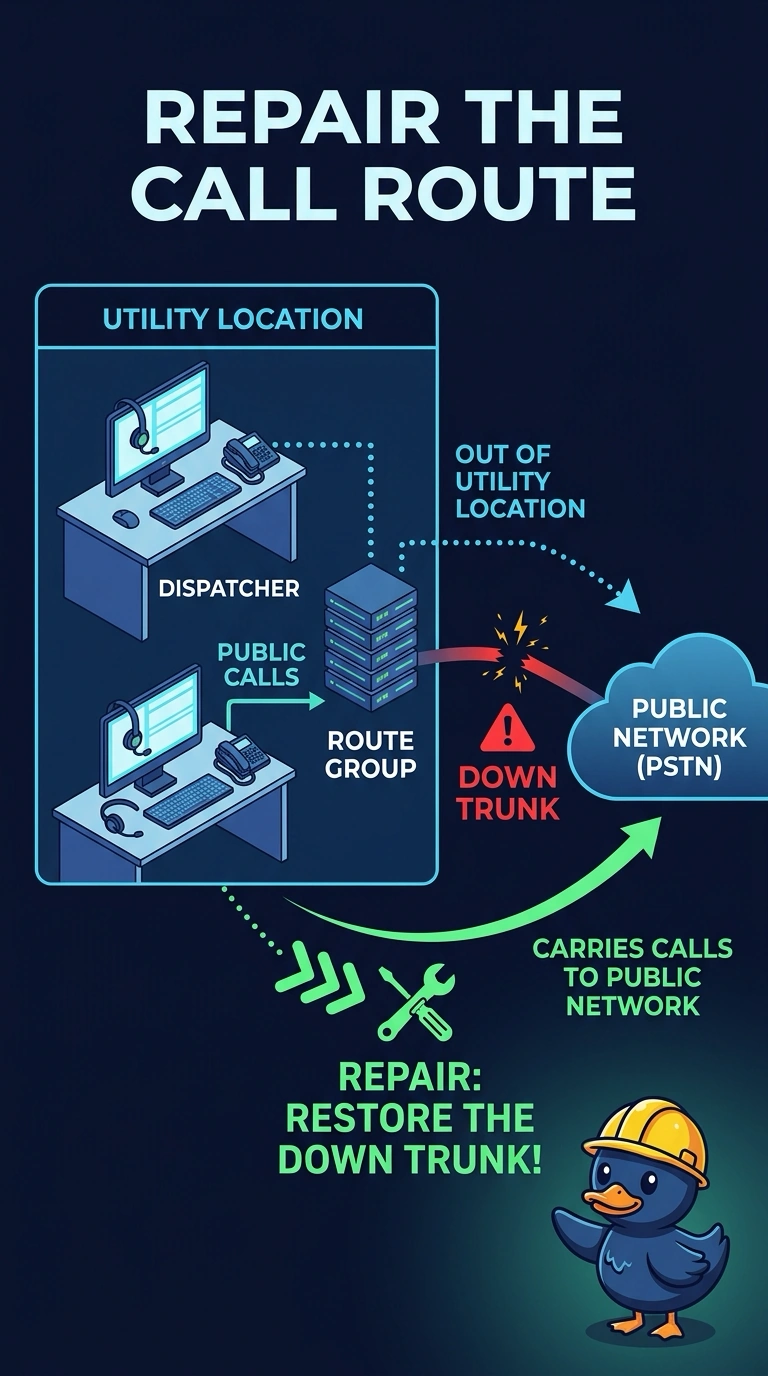
A utility dispatcher is registered to Webex Calling and can reach every internal extension, but public-network calls fail. Coworkers in the same location with the same call permissions complete those public-network calls, and this dispatcher's calls are sent to a route group whose trunk is down. Which item should be repaired?
Select an answer to reveal the explanation.
Short Explanation
The house intercom can work perfectly while the outside line is dead. You repair the down trunk in the route group that should carry the public-network calls, because coworkers with the same permissions already get out. The trap is blaming a meeting lobby or a digit rewrite for a path that does not leave the site.
Full Explanation
A registered user who can call internal extensions and cannot reach the public network has a trunk, route, or permission problem, not a registration problem. Here the permissions match coworkers who succeed, and the dispatcher's calls go to a route group whose trunk is down, so you repair the down trunk in the route group that should carry this dispatcher's public-network calls out of the utility location. The cloud meeting lobby, on the theory that a meeting join control is also blocking this dispatcher's outside calls, confuses a meeting admit step with calling. A meeting lobby does not carry a public-network call. A translation pattern, on the theory that rewriting the dialed digits will choose a trunk and allow the public-network call, only rewrites digits: it does not choose the trunk and it does not decide whether the call type is allowed. The Directory Connector service, on the theory that a stopped user sync is why outside calls fail while internal calls still work, is a directory fault, and this phone is already registered and placing internal calls. On the exam, match the symptom to the path: same permissions, failed trunk, fix the trunk. In operations, bring that trunk up and place one public-network call, then confirm an internal extension still works.