
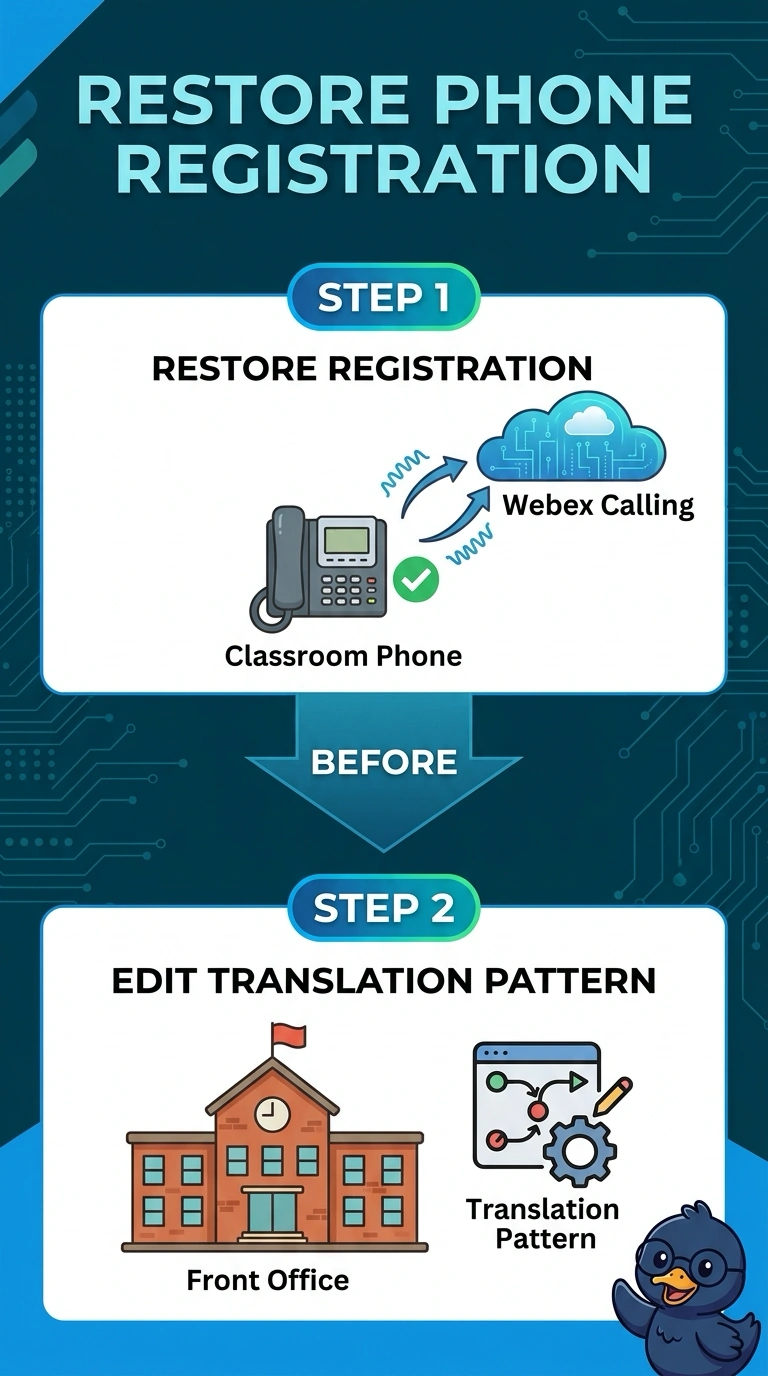
A school help desk finds one classroom phone unregistered and starts editing a translation pattern so that handset can reach the front office. Which action addresses the failure?
Select an answer to reveal the explanation.
Short Explanation
Repainting a street sign does not start a car that has no engine. You restore the classroom phone registration before you touch a translation pattern, because a pattern cannot register a handset. The trap is rewriting digits while the phone is still unregistered.
Full Explanation
Webex Calling keeps registration, digit rewrite, and public-network reachability as separate faults. A phone that is not registered cannot be repaired by a translation pattern, so you restore that classroom phone's registration to Webex Calling before any translation pattern is edited. Until the handset is registered, changing digits has no phone to serve. Rewriting the classroom translation pattern so the unregistered extension is converted into the front-office number before any routing only changes dialed digits, and it does not create a registration. Changing the school meetings-site lobby settings so the unregistered classroom handset is treated as a meeting-join problem moves the work into meetings, while this failure is a calling registration. Assigning a spare number that already lives in another campus location to this unregistered classroom phone still leaves the handset unregistered, and a number housed in another location is not an assignment that brings this phone online. On the exam, an unregistered phone is fixed by restoring registration, and a translation pattern is the wrong tool for that state. In operations, confirm the classroom phone shows registered to Webex Calling, then place the front-office call before anyone edits a pattern.