
A bank registration trunk rejects calls for capacity while a second registered trunk sits idle and is not in the route group the dial plan uses. How should that extra capacity be used?
Select an answer to reveal the explanation.
Short Explanation
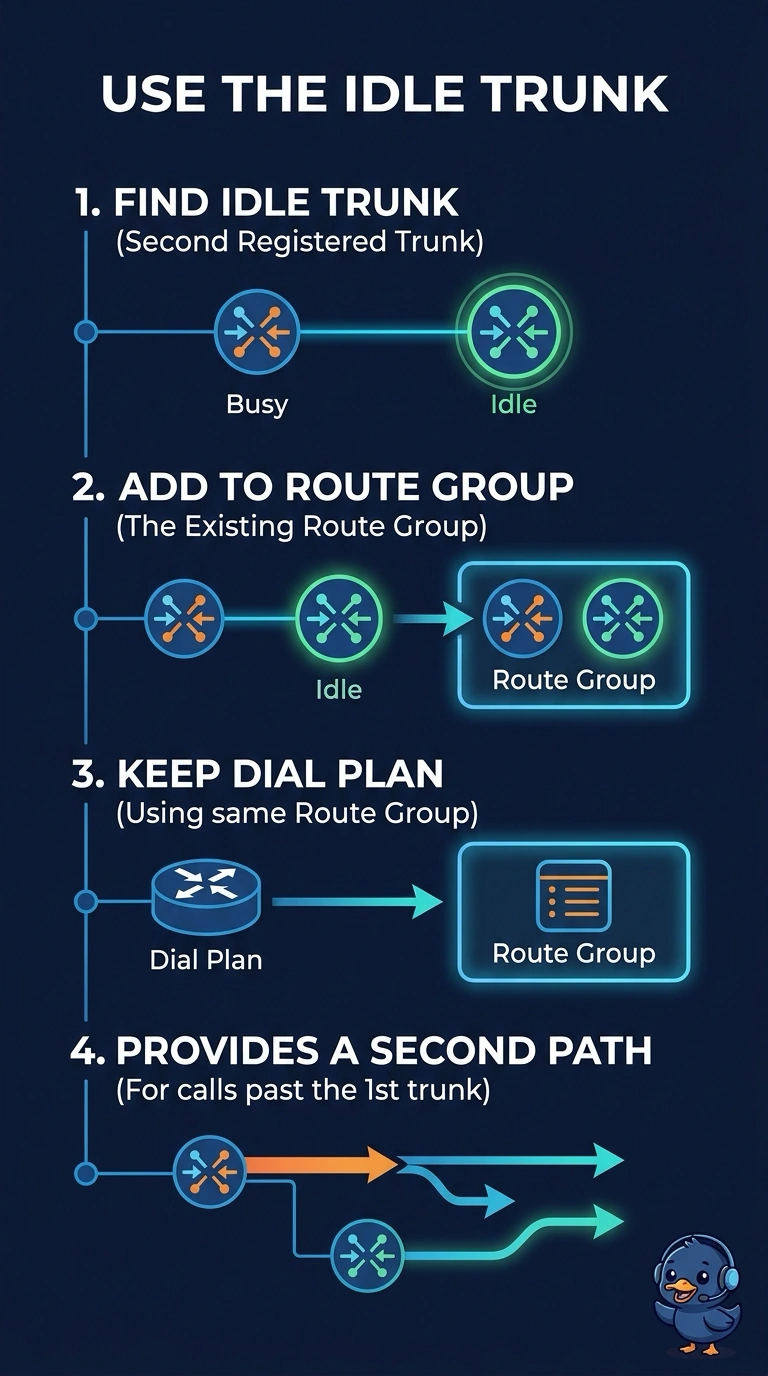
The second trunk is an extra checkout lane that was built and then left off the lane lights. You add that idle registration trunk to the route group the dial plan already uses. The trap is trying to stretch one registration past its limit on the same trunk.
Full Explanation
Calls past a registration trunk's capacity are rejected. More capacity means another trunk in a route group, not a larger registration on the same trunk. The idle trunk is already registered, but the dial plan sends calls to a route group that does not include it. Add the second trunk to the selected route group and configure priorities to match the intended load distribution and failover. Raising the call capacity of the registration already configured on that same trunk does not lift the per-trunk cap, and it leaves the idle trunk unused. Converting the idle trunk to a certificate-based mutual TLS trunk changes the trust model. Route group membership is not limited to that model, and mutual TLS is not what makes a trunk eligible. The idle registration trunk can join the group as it is. Changing the callers' international call permission allows or blocks a call type. A capacity rejection is not proof that the international call type is blocked, and a permission change does not add a trunk. Exam caveat: a route group is also the failover list, so order the trunks the way you want overflow to try them, and remember a route group does not itself change call permissions. Operational check: place calls until the first trunk would have rejected them and confirm they proceed on the newly added trunk.