
A warehouse team wants Control Hub to validate the configuration of an enrolled IOS XE Cisco CUBE that will be their local gateway. The CUBE platform and deployment mode support Control Hub configuration validation. Which trunk model provides that validation?
Select an answer to reveal the explanation.
Short Explanation
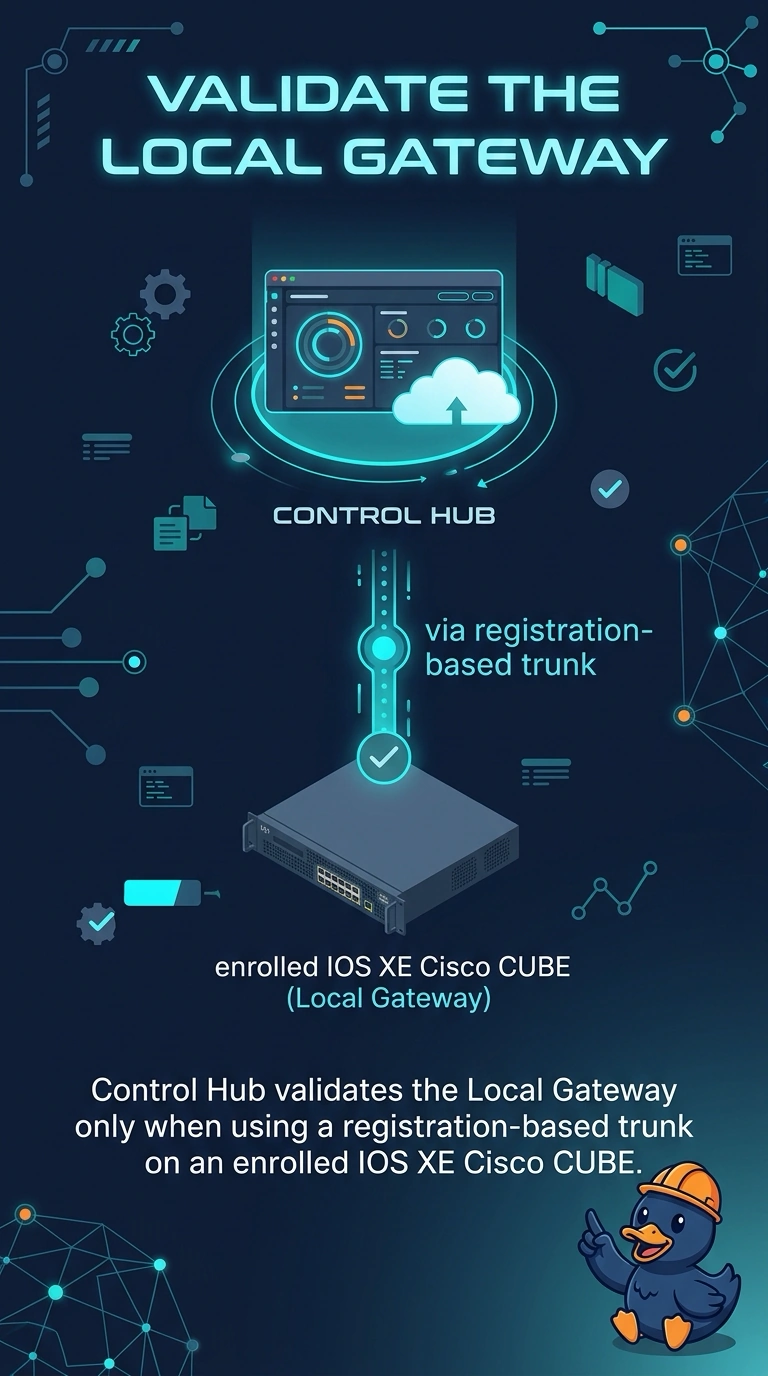
Control Hub's configuration check is like an inspector who stamps only one kind of permit. You get that check on a registration-based trunk when the IOS XE CUBE is enrolled. The trap is switching to mutual TLS because it sounds stricter and therefore more official.
Full Explanation
When an IOS XE gateway is enrolled, Control Hub can validate the configuration of a registration-based local gateway. Registration-based validation requires a supported enrolled gateway; Cisco lists exceptions, including ISR 1100. The warehouse should use a registration-based trunk on that enrolled IOS XE CUBE. A certificate-based mutual TLS trunk does not receive that help. Control Hub does not offer automated configuration troubleshooting for the certificate-based model, so choosing it in order to get troubleshooting selects the model that lacks the check. A public DNS SRV record is part of bringing a certificate-based trunk online, along with a verified domain and a CA-signed certificate. Publishing that name does not start configuration validation, and a registration-based trunk does not require a public DNS name. Colocating a Survivability Gateway on the same router is supported, but site survivability is backup calling when the cloud path fails. It is not configuration validation of the local-gateway trunk. Exam caveat: registration-based validation still depends on the gateway being enrolled, and the trunk itself uses digest registration on Cisco CUBE. Operational check: enroll the CUBE, apply the registration-based trunk, and confirm Control Hub reports a configuration validation result for that gateway.