
A factory rotated the local-gateway registration password in Control Hub, but the Cisco CUBE still sends the previous digest secret and the trunk stays down. What should be updated on the gateway?
Select an answer to reveal the explanation.
Short Explanation
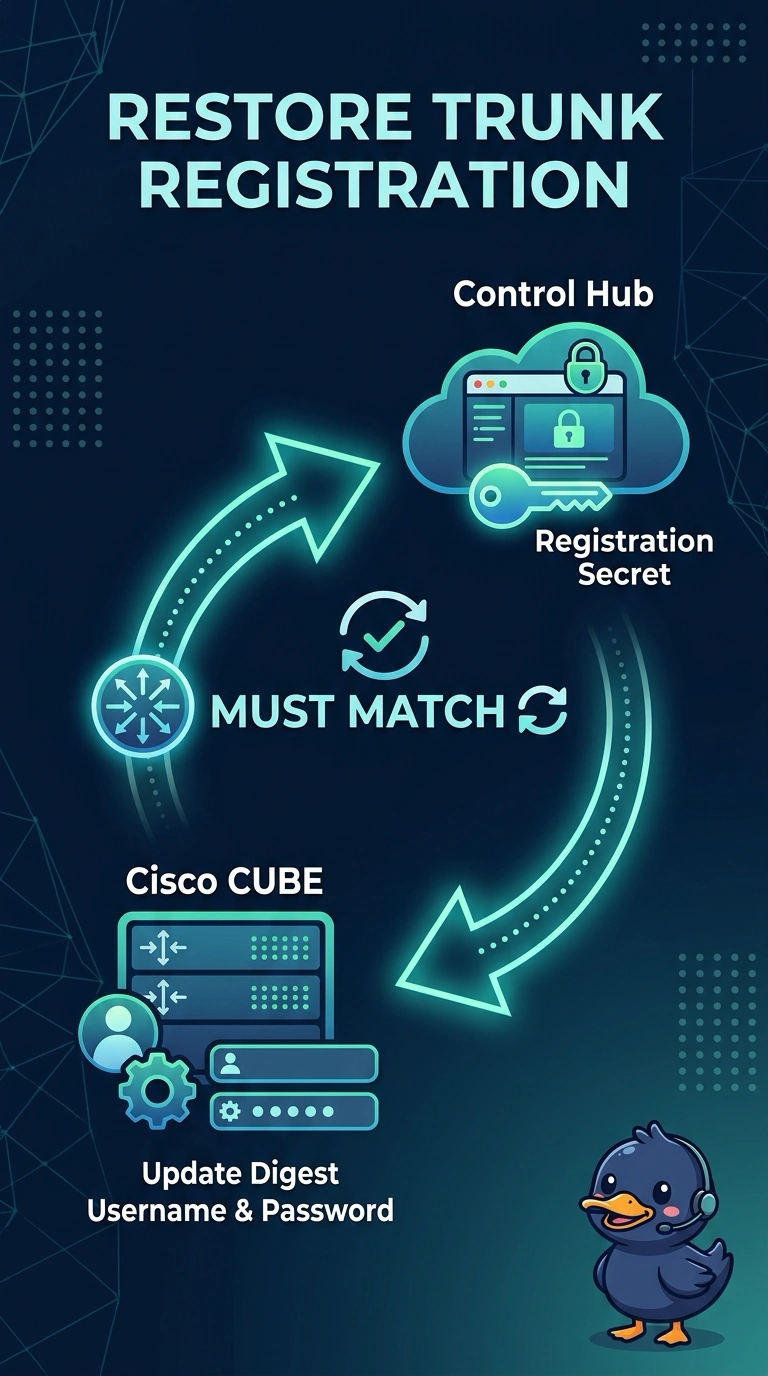
Think of the rotated registration secret as a new door code that the CUBE has not learned yet. Update the digest username and password on the CUBE to match Control Hub. A new TLS certificate does not replace the password used by this registration-based trunk.
Full Explanation
A registration-based trunk registers outbound using a digest username and password. After you rotate the registration password in Control Hub, the Cisco CUBE must send the updated secret; updating its digest username and password to match Control Hub restores the credential match. Installing a new CA-signed TLS certificate does not change the digest secret: that certificate is used for certificate-based trunk authentication, and a registration-based trunk does not prove its identity with that certificate alone. Publishing a public DNS A record does not update or store the rotated password; the registration secret is held in Control Hub, not public DNS. Converting the trunk to mutual TLS changes the authentication model rather than refreshing the digest credential. Certificate-based trunks rely on certificates, not password rotation, and require the applicable certificate-based setup. Exam caveat: a certificate change can matter when configuring certificate-based authentication, but it does not fix a registration-based trunk that is sending an old digest secret. Practical check: enter the new digest password on the CUBE, trigger registration, and confirm that the trunk shows as registered in Control Hub.