
A hotel already synchronizes users with Directory Connector, and an administrator also connects Okta SCIM so both can update the same organization. Which directory design is supported?
Select an answer to reveal the explanation.
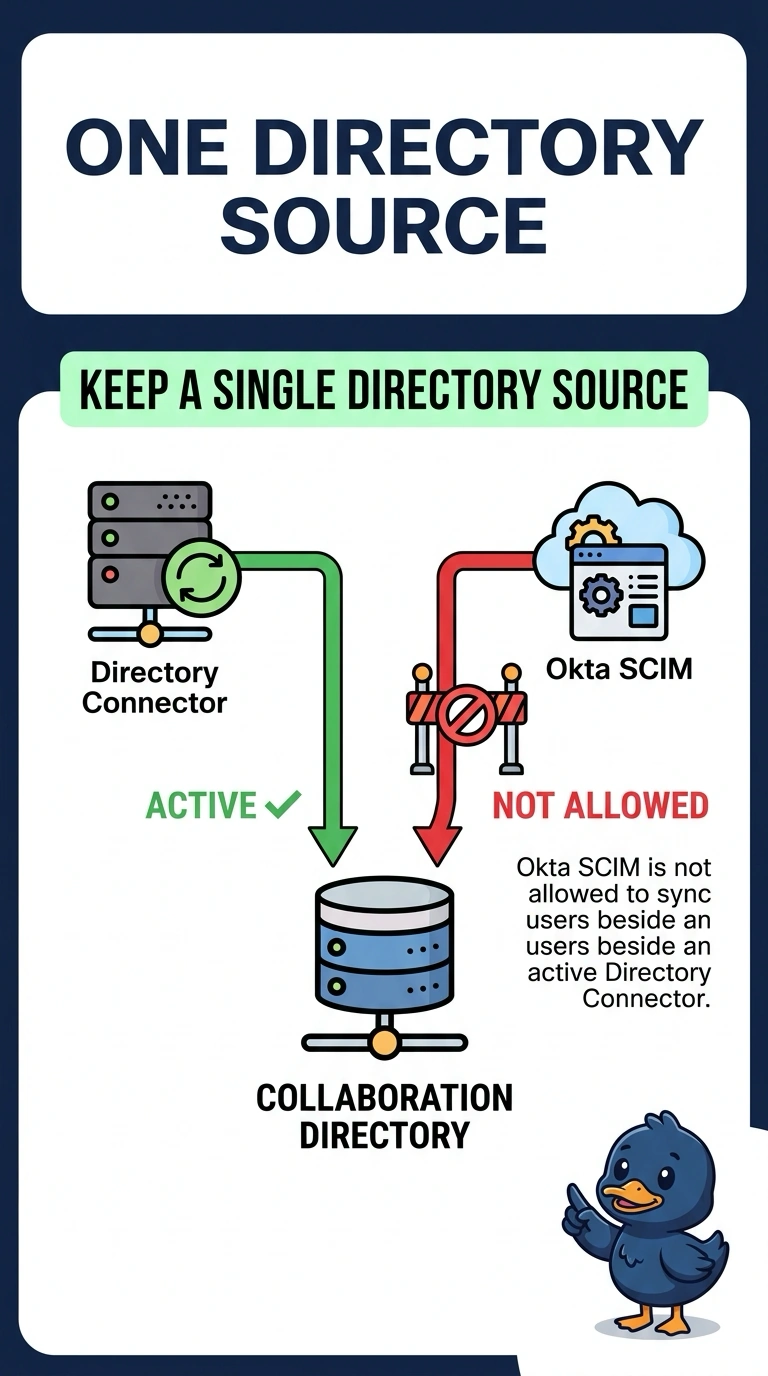
Short Explanation
Think of two clocks on the same wall, each insisting it is the one that sets the official time. You keep a single directory source, because Okta SCIM is not allowed to sync users beside an active Directory Connector. The trap is letting the newest update win, merging the sources with a dial plan, or activating a UC cluster and calling that a directory design.
Full Explanation
Directory synchronization has one owner for the organization. Directory Connector is already synchronizing this hotel from Active Directory, so Okta SCIM cannot be added as a second owner. The supported design is to keep a single directory source, because Okta SCIM is not allowed to sync users beside an active Directory Connector. Running Okta SCIM and Directory Connector together and letting the most recent update win for each hotel user attribute in turn is two sources, and the organization does not pick a winner between them. Pointing a calling dial plan at Okta so the dial plan can merge the two directory sources into one organization uses a dial plan, which selects call routing and does not merge directories. Activating Cloud-Connected UC for a cluster and using that activation in place of choosing one directory source connects an on-premises UC cluster for operations, and that activation does not replace the directory-source rule. Exam caveat: Okta SCIM is a valid source when it is the only owner, and it is not valid beside Directory Connector. Operational check: disconnect the extra Okta SCIM sync, confirm only Directory Connector is writing users, and add a test user in Active Directory rather than in both tools.