
A nurse transferred from the clinic calling location to the hospital calling location but still uses the clinic route group while holding the hospital international permission. How should that dialing be corrected?
Select an answer to reveal the explanation.
Short Explanation
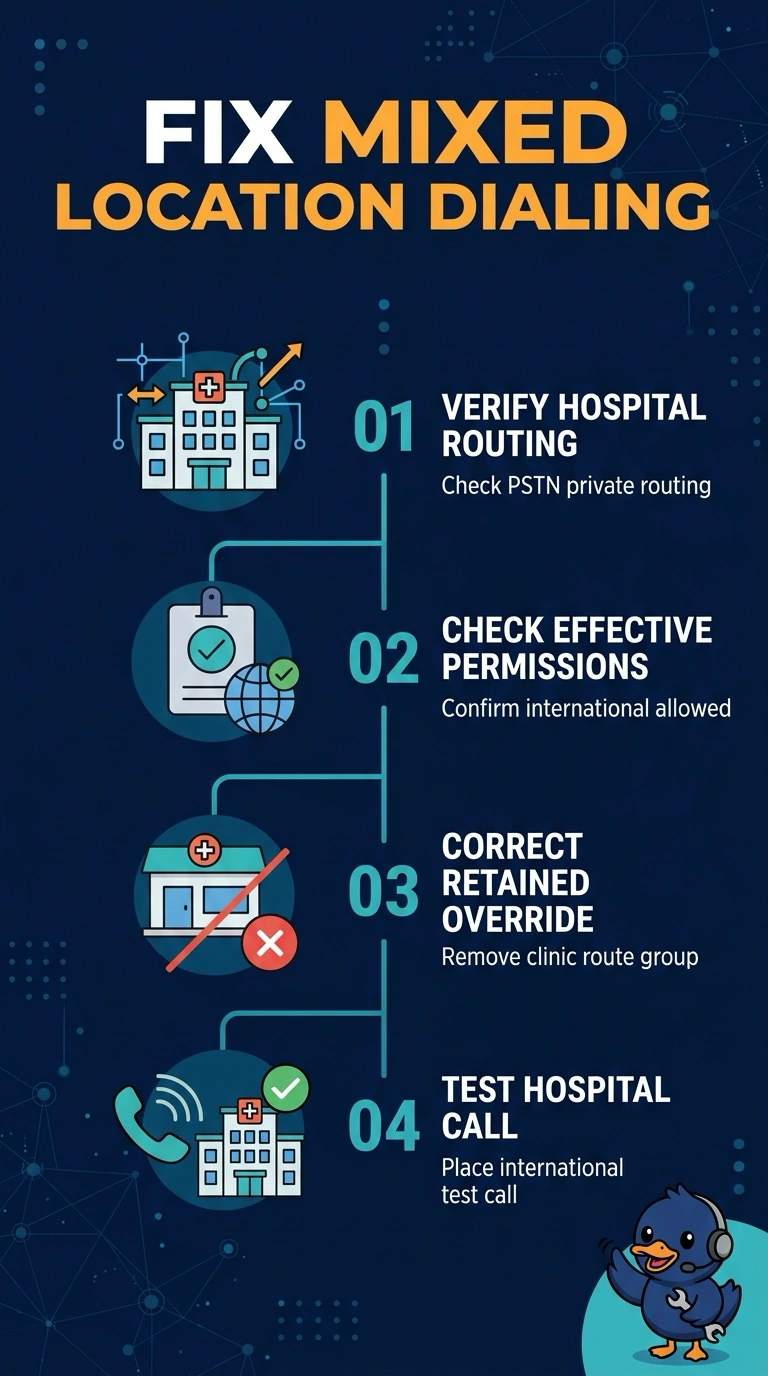
This nurse is carrying one city's map and another city's tickets. You rebuild location dialing so the hospital route group and the hospital call permissions travel together. The trap is keeping the clinic route group and hoping a translation borrows the new permission.
Full Explanation
A user who moves sites must not keep the old site's route group mixed with the new site's call permissions. The nurse now belongs to the hospital calling location, so check the hospital location’s PSTN routing and the nurse’s effective outbound permissions, and correct any retained user override or matching route. The selected route depends on the dialed destination and configured PSTN or private routing. Keeping the clinic route group sends calls toward the clinic trunks. A translation pattern rewrites digits, and it cannot borrow the hospital location's international call permission, because a permission allows or blocks a call type and a translation does not grant that permission. Deleting the hospital calling location removes the site the nurse just joined. A Survivability Gateway is for basic backup calling when the cloud path fails, not for everyday calls that leave the site after a transfer. Leaving the clinic route group beside the hospital international permission preserves the mixed state. A location move does not safely leave previous dialing unchanged, because the route and the permission would still describe two different sites. Exam caveat: a translation that is correct at the clinic can strip digits the hospital carrier still needs, so copy patterns only after you check both locations. Operational check: place an international test call as the nurse and confirm it uses a hospital trunk and the hospital permission, with no clinic route group left on the user.