
A utility translation strips a prefix that the carrier at location A accepts, but the carrier at location B still requires that same prefix. How should the strip be applied?
Select an answer to reveal the explanation.
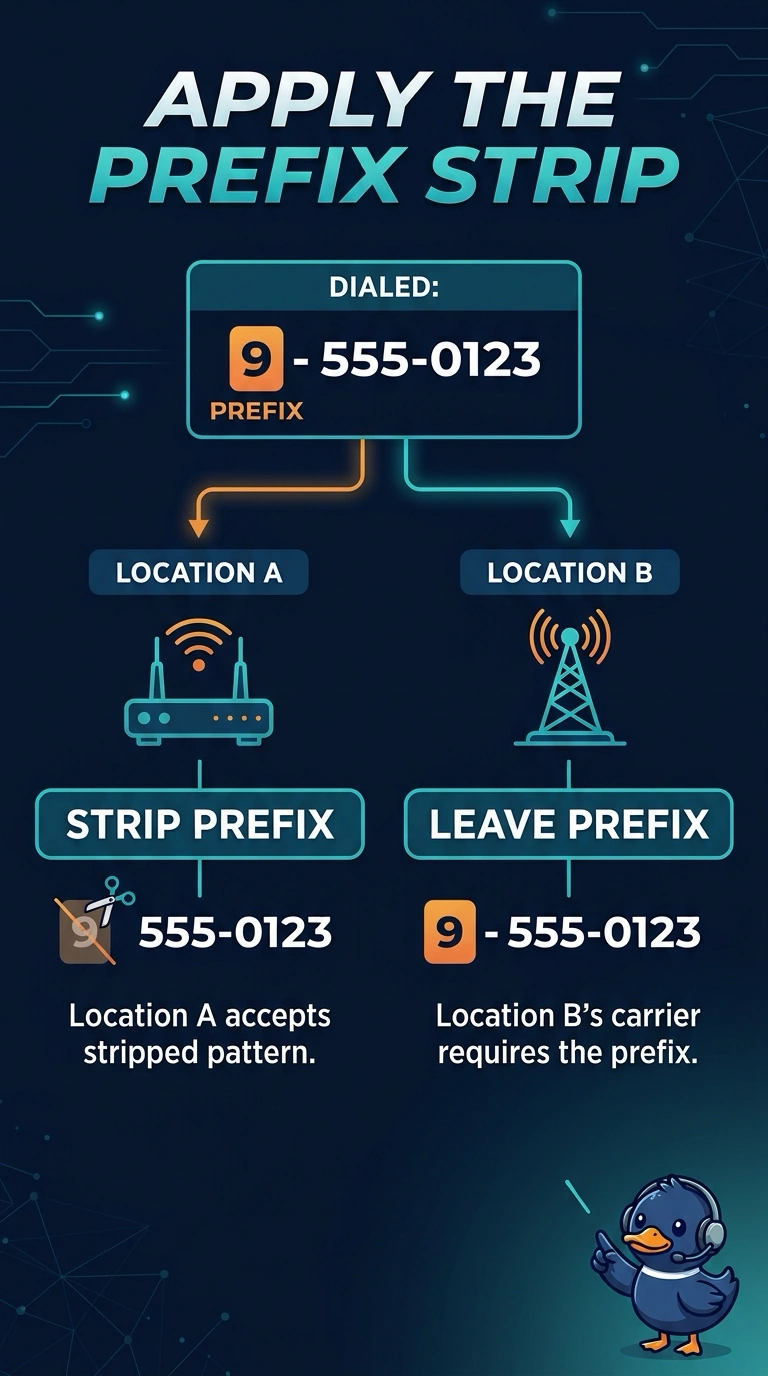
Short Explanation
A prefix strip that helps one carrier is like dropping a postal code the next desk still demands. You keep the strip only at location A and leave the prefix in place at location B. Applying the same strip at both locations would send location B a number its carrier still requires digits for.
Full Explanation
A translation pattern rewrites digits, and a rewrite that works for one location can remove digits another location needs. Location A's carrier accepts the shortened number, so you apply the prefix strip only at location A. Location B's carrier still requires those digits, so you leave the prefix in place there. Applying the same prefix strip at both locations would send location B's carrier a number it will not accept; sharing a translation is not appropriate when the carriers have different digit requirements. Removing international call permission at location B would block that call type, but a missing prefix is a digit-translation problem, not proof that the call type is blocked, and call permissions do not restore digits. A route group is an ordered set of trunks used for capacity and failover; sending both locations through one route group without translation would not rewrite the called digits, because a route group does not perform translation. Exam caveat: the dial plan must point each location to the appropriate pattern, or a shared pattern may still strip digits location B needs. Practical check: place the same call from each location and confirm that location A sends the stripped number while location B sends the prefix its carrier requires.