
A school WAN shows spare capacity on the utilization graph, yet voice calls still break up whenever large file copies run on the same link. What is the missing treatment?
Select an answer to reveal the explanation.
Short Explanation
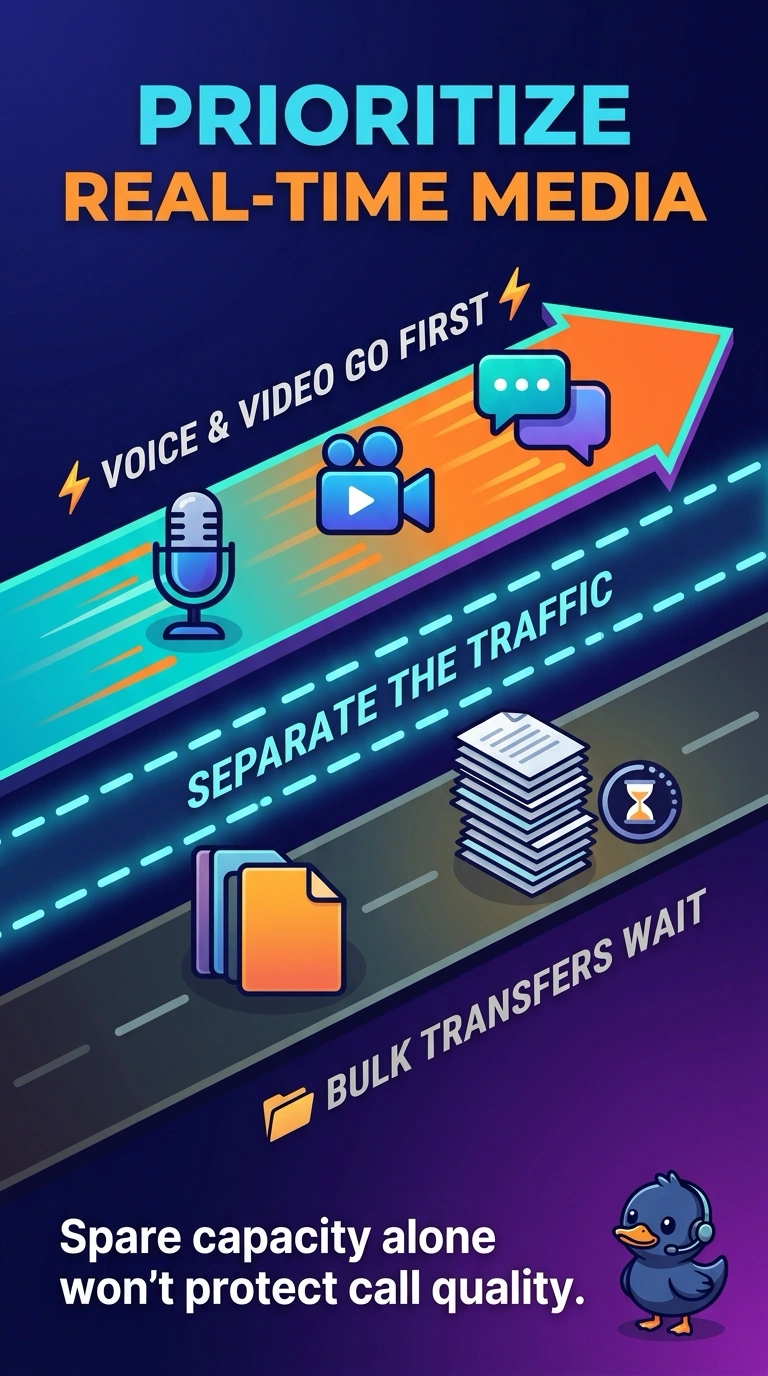
A wide road still feels jammed when dump trucks and ambulances share one lane with no way for you to let the ambulance go first. The school link has spare capacity on paper and still drops voice because bulk copies are not separated from real-time media. A new auto attendant will not build that priority.
Full Explanation
The utilization graph already shows spare capacity, so the link is not simply out of room. Voice breaks up while bulk copies run because real-time voice and video are not preferred over those transfers. Priority for real-time voice and video over bulk transfers, because spare bandwidth on paper still drops voice when bulk traffic is not separated from the media. A new auto attendant for the main office, because a greeting menu is what separates voice from those bulk file copies. An auto attendant answers a call and plays a menu. It does not separate bulk transfers from real-time media. A directory resync, because user accounts on the wrong domain are what drop voice packets during a file copy. A directory resync repairs identity data and does not change how the WAN treats voice packets. A replacement of the calling dial plan, because digit patterns are what mark voice packets and a pattern change is what protects them on a link that has spare capacity. A dial plan chooses patterns and routes. It does not prefer voice and video over file copies. Exam caveat: Do not attach a specific marking number that has not been confirmed. The requirement is that voice and video are preferred over bulk traffic. Operational check: While a large file copy runs, place a voice call across the school WAN and confirm it stays clear once real-time traffic is preferred, with the auto attendant left unchanged.