
A bank adds new tellers to an Active Directory organizational unit, and those people do not appear in Control Hub. The Directory Connector log says the service is stopped. Which action brings the tellers in?
Select an answer to reveal the explanation.
Short Explanation
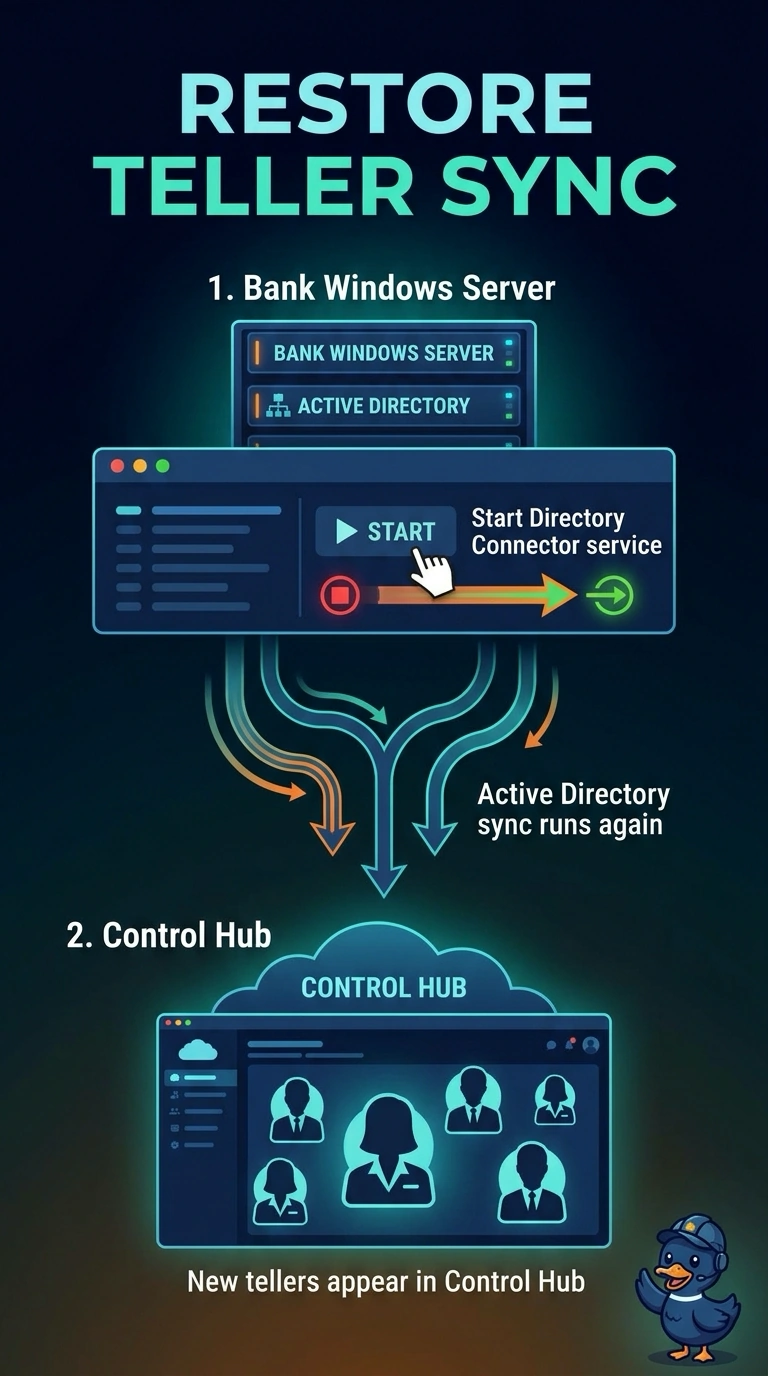
A mail truck parked in the garage delivers nothing, no matter how many new names you add to the route. You start the Directory Connector service so the bank sync from Active Directory can run again. The trap is building a calling location, or typing users by hand, and expecting that to replace the stopped sync.
Full Explanation
Directory Connector is the on-premises Windows sync from Active Directory into Control Hub, and Active Directory stays the source of truth while that connector owns the organization. A stopped service means the sync is not running, so new tellers in the organizational unit never arrive. You start the Directory Connector service on the bank Windows server so the stopped Active Directory sync runs again and the new tellers appear in Control Hub. Creating a new calling location for the branch and expecting that location to import the new tellers from Active Directory builds a calling site, and a location does not read Active Directory. Rotating a SCIM token in the cloud identity provider so the stopped on-premises connector service starts again confuses two provisioning models: a SCIM token rotation does not repair an on-premises connector. Adding each teller by hand in Control Hub while Directory Connector still owns the bank user directory fights the source of truth, and those hand-built users are not how this connector-owned organization is maintained. On the exam, a stopped connector is repaired by starting that sync, not by a calling object or a cloud token. In operations, confirm the connector service is running and that a newly added Active Directory teller appears in Control Hub after the sync.