
A logistics firm adds warehouses weekly. Each new site must reach other warehouses directly across the internet, and that traffic must be encrypted. Which tunnel design fits?
Select an answer to reveal the explanation.
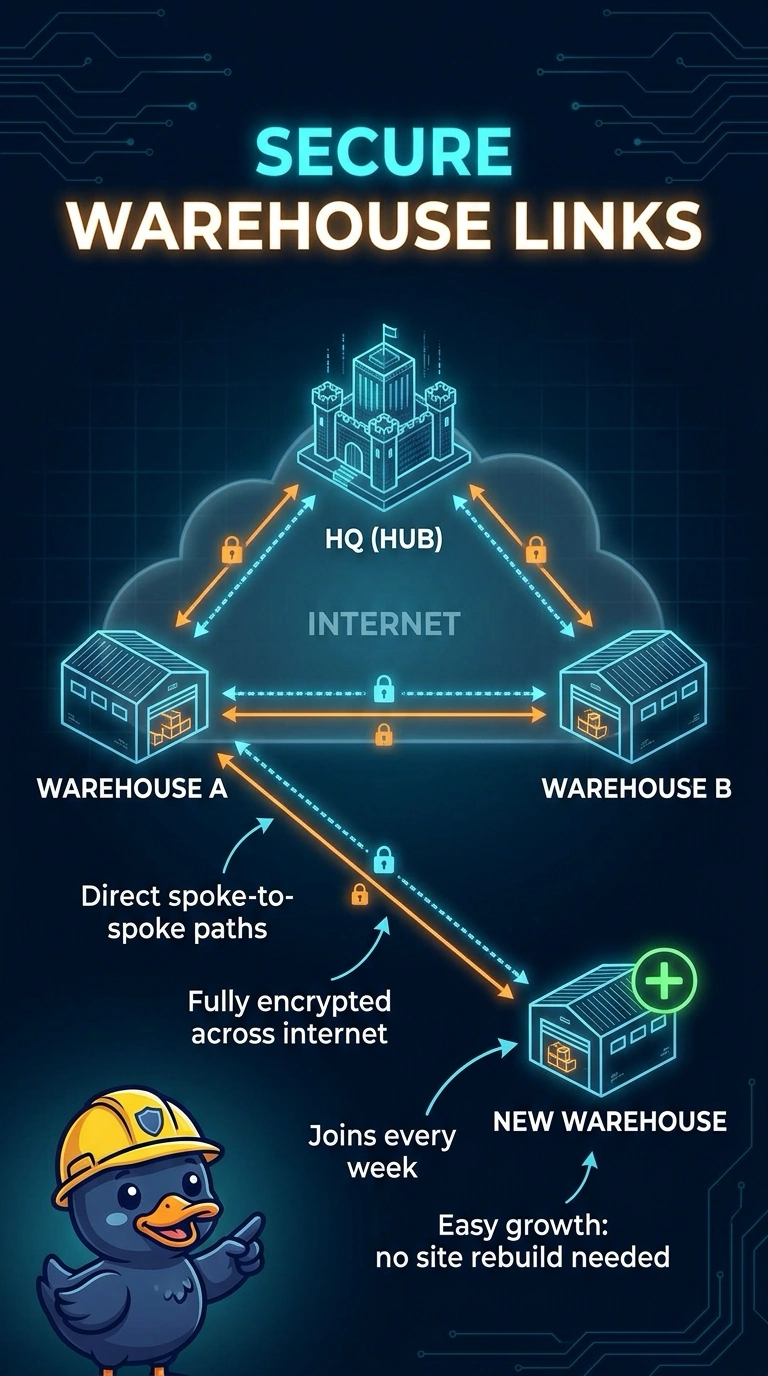
Short Explanation
You need direct warehouse-to-warehouse paths over the internet, with the traffic protected by encryption. Encrypted dynamic spoke-to-spoke tunnels let a new warehouse join without rebuilding every site; GRE tunnels only encapsulate, an MPLS forwarding label does not encrypt, and a static mesh requires hand edits as sites are added.
Full Explanation
Because warehouses are added weekly, they need to communicate directly rather than send traffic through a permanent hairpin, and the internet path requires encryption. Encrypted dynamic spoke-to-spoke tunnels let a new warehouse join without a hand edit at every existing site, so they meet both the direct-communication and growth requirements. GRE tunnels between spokes that encapsulate the traffic and do not encrypt it are unsuitable because GRE carries the packets but leaves the payload readable on the internet path. An MPLS service where the provider only applies a forwarding label is also unsuitable: the label is a provider forwarding mark, not encryption of the warehouse payload. A static mesh of tunnels that must be edited at every warehouse each time one site is added could provide encryption, but it fails the weekly-change requirement because every existing site needs a manual update. Exam caveat: Confirm that the dynamic spoke-to-spoke sessions are actually encrypted; dynamic tunnel establishment alone does not protect payloads. Practical check: Add a lab spoke, verify that it reaches an existing spoke without a manual edit at that site, and inspect a capture on the internet path to confirm the warehouse payload is not visible.