
A pharmacy already encrypts the site link between its cloud and the data center, yet every job in the cloud subnet can query inventory. Which design restricts that path to the ordering API?
Select an answer to reveal the explanation.
Short Explanation
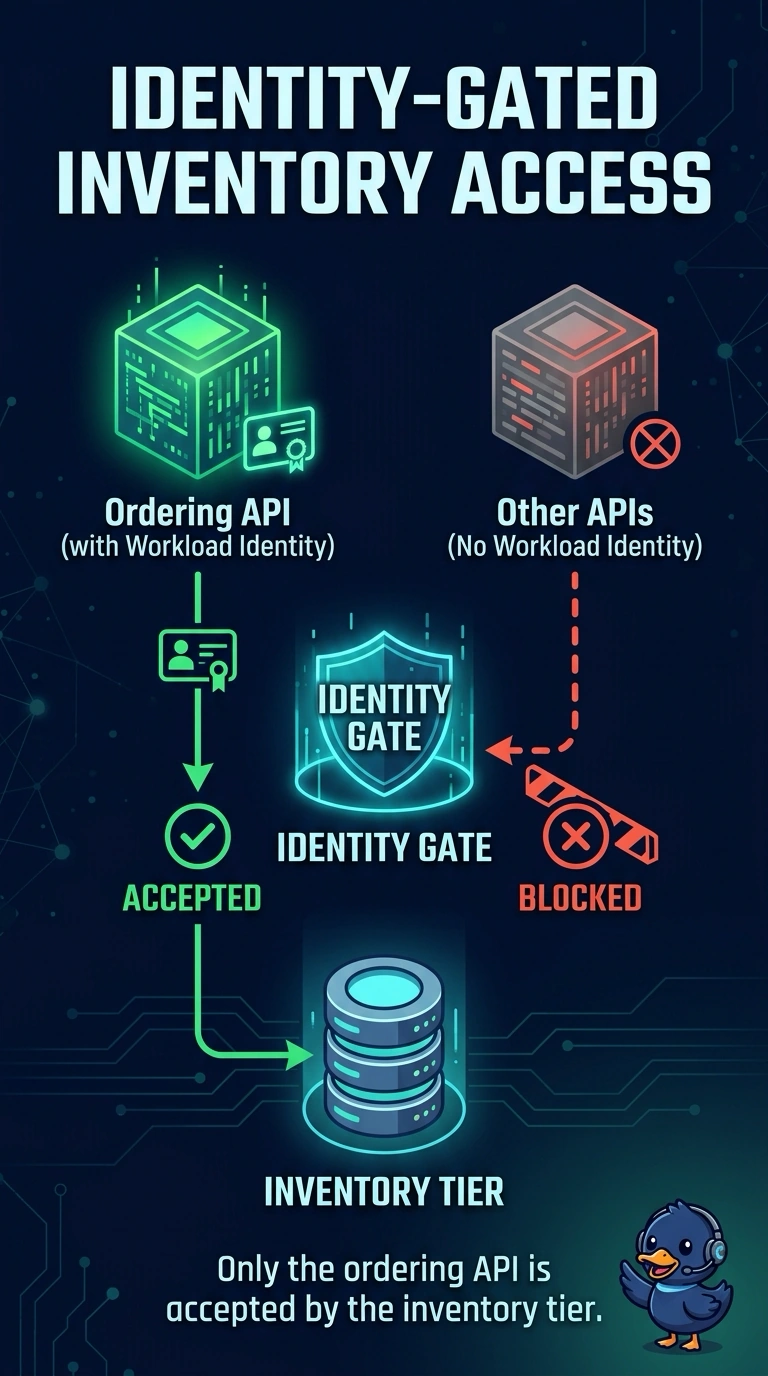
Even with an encrypted link, you still need to identify who may reach inventory. Workload identity lets you accept calls only from the ordering API; another tunnel, a subnet-wide edge rule, or a laptop web filter does not identify that caller.
Full Explanation
The site link is already encrypted, but every job on the cloud subnet can still query inventory. Workload identity at the inventory tier accepts only the ordering API, so a batch job on that subnet cannot use the encrypted link as if it were the API. A second site-to-site tunnel repeats encryption without restricting which jobs can query inventory. An edge firewall rule that continues to allow the entire cloud subnet preserves the broad access path instead of limiting it to the ordering API. A laptop web filter inspects staff browsing, not inventory calls from cloud jobs, so it does not control this path. Workload identity so only the ordering API is accepted by the inventory tier is the design that meets the requirement. Exam caveat: Keep the existing encryption; identity does not replace it, and an encrypted private path alone does not specify which workloads may use it. Practical check: From a lab batch job on the same subnet, try querying inventory and confirm the request is refused, then verify that the ordering API can still read a current stock row.