
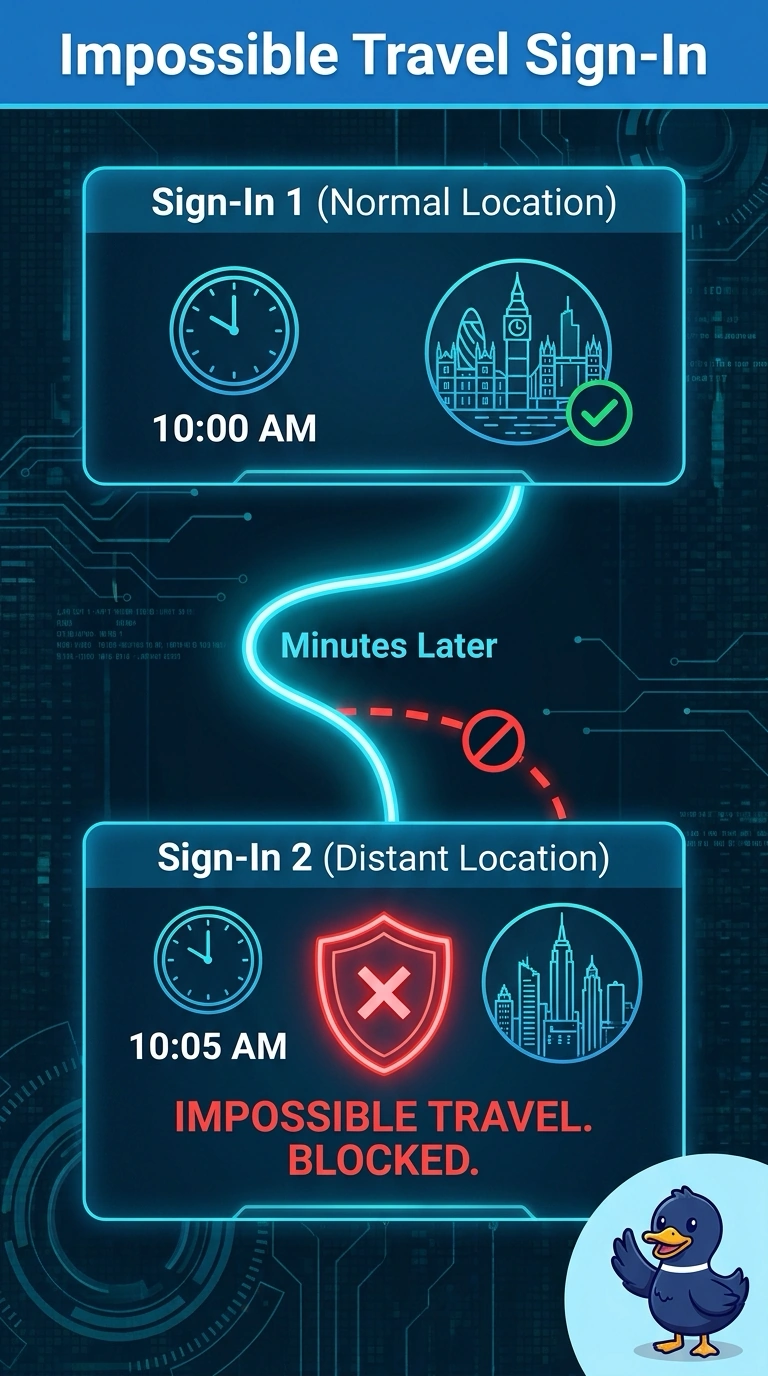
A payroll bureau sees the same clerk succeed at the office and, minutes later, succeed from a country the clerk has not visited. Session theft is suspected. The source locations are reliable, far enough apart to rule out travel, and the second action triggers a fresh access decision. Which control fits this sign-in?
Select an answer to reveal the explanation.
Short Explanation
A badge that works in two countries a few minutes apart is not a busy traveler. You score the sign-in and you challenge or block the impossible trip. A relayable text code, a security question, or a tunnel that only checks the password lets the second success stand.
Full Explanation
The two successes cannot both be the clerk traveling in a few minutes, so the control that fits scores sign-in risk and can stop the second session on this payroll account. A text-message code is relayable and does not understand place, a security question is another secret the mailbox can reset, and a password-only tunnel will accept the stolen sign-in. An identity-risk control that challenges or blocks the second sign-in as impossible travel is the design that meets this requirement. Challenge or deny the attempt and revoke a stolen session if investigation confirms replay. A text-message code that a prompter can relay from the clerk in real time is the wrong fit because a code prompted in real time can be relayed, and it does not score impossible travel. A security question whose answer was reset by the same mailbox the attacker can read is the wrong fit because it is a reusable secret, and mailbox access lets the attacker set a known answer. A remote-access tunnel that accepts any valid password and does not score the sign-in is the wrong fit because it treats the distant sign-in as normal and misses the travel. Exam caveat: Risk scoring needs fresh location; treat missing location as unknown, not success. Operational check: Sign in from office then distant test network and confirm challenge or block with travel rule logged.