
A storm saturated a tug operator's forwarding plane and cut off in-band management while the routers themselves stayed up. Which design restores a management path that does not depend on that plane?
Select an answer to reveal the explanation.
Short Explanation
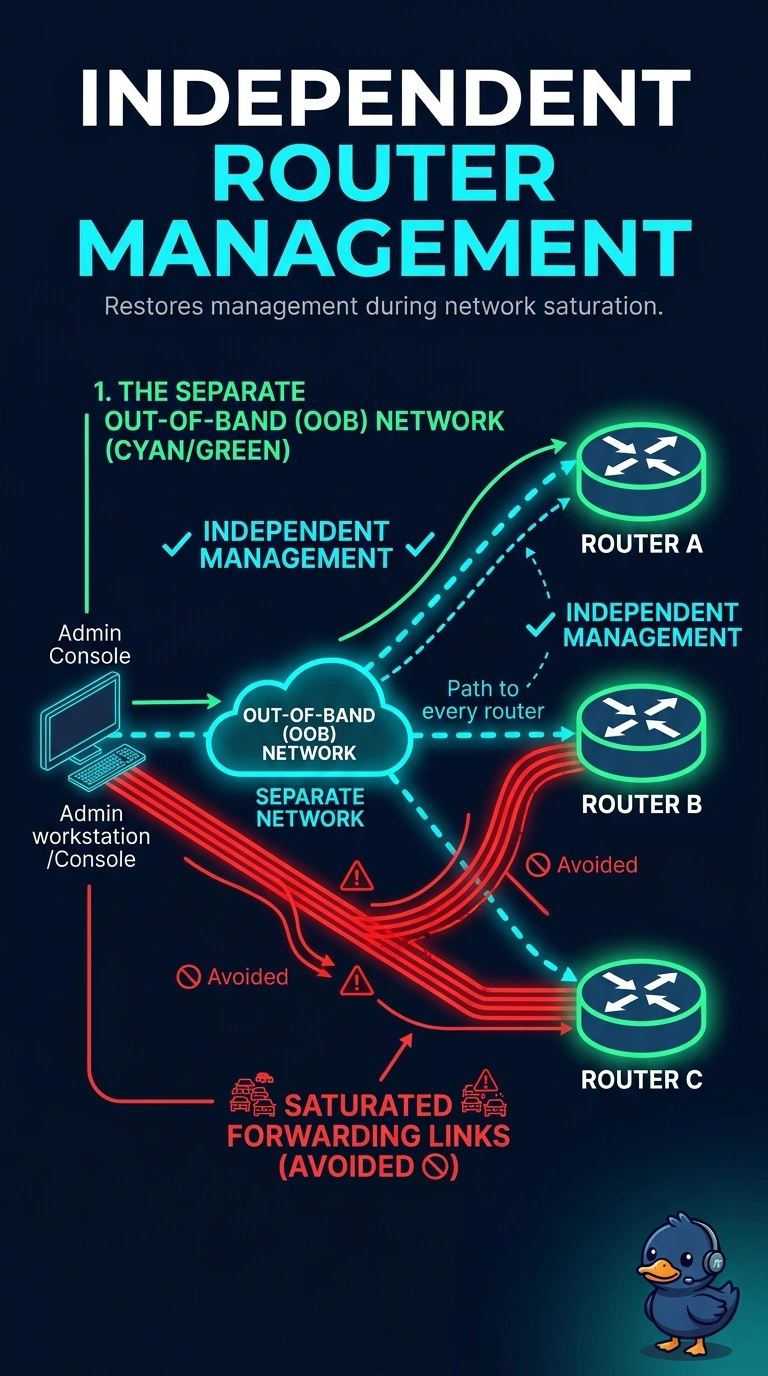
When the forwarding plane is jammed, you still need a separate way in. An out-of-band management network lets you reach the tug routers without using the saturated links. A crew web filter, routing-protocol authentication, or encrypted sessions on those same links won’t get you through the jam.
Full Explanation
In-band management died because it used the same forwarding plane that saturated. An out-of-band management network gives operators a path that does not depend on those links, so the routers remain reachable while the data plane is unusable. A web filter on the crew entertainment network, with no path for operators to reach the routers, does not provide that access: crew web browsing is not a management path. Routing-protocol authentication that still leaves management on the failed in-band links authenticates routing peers but does not make those links usable or create another path. Encrypted admin sessions that still ride the same in-band links protect the session, but it still has to cross the forwarding plane that went silent. The out-of-band management network is the design that meets the requirement. Exam caveat: If the out-of-band path is reachable from the crew network, it recreates an in-band exposure, so limit that path to the operator station. Practical check: In a lab, saturate the forwarding links and confirm that an out-of-band session to a router still answers while an in-band session does not.