
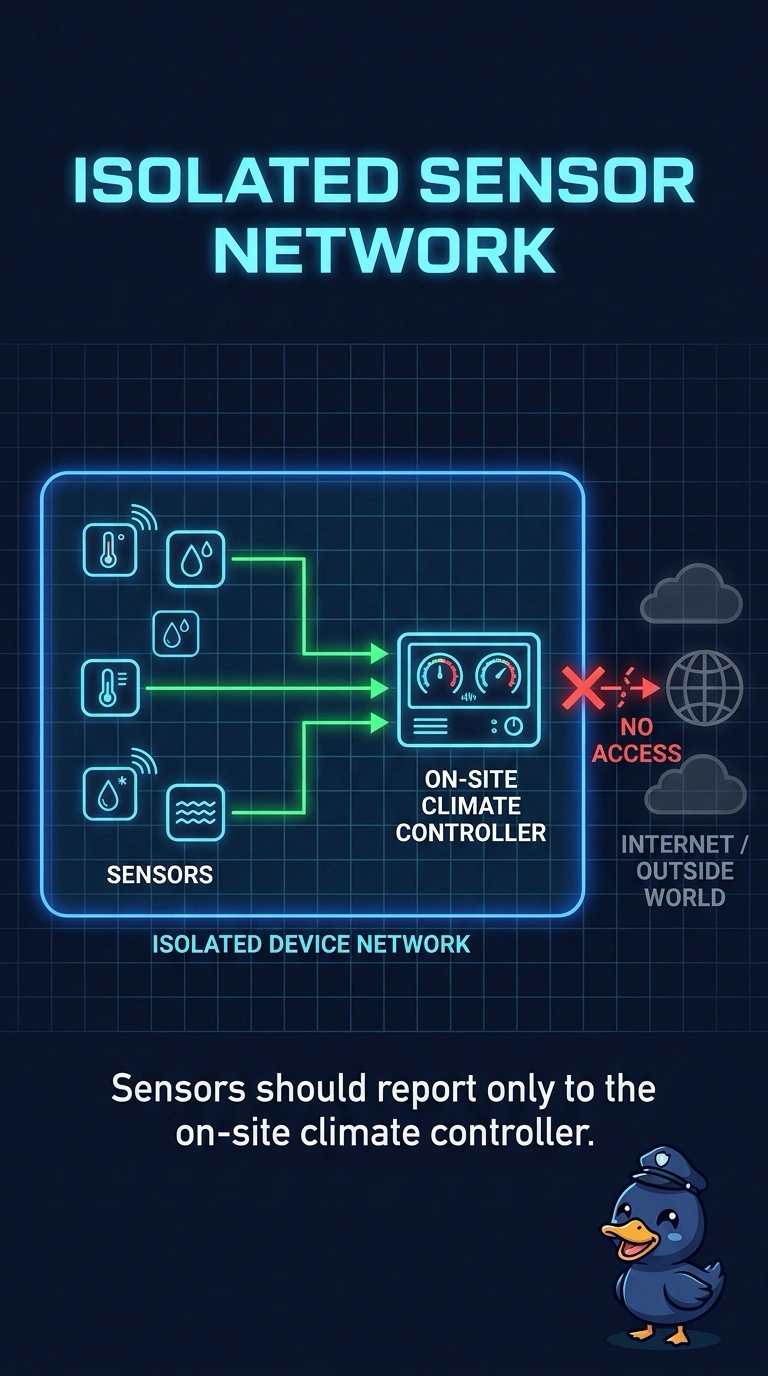
A commercial greenhouse has climate sensors that cannot run a user agent or accept patches. They should report only to the on-site climate controller. Which design places them correctly?
Select an answer to reveal the explanation.
Short Explanation
These sensors are thermometers, not laptops, so you cannot ask them to run your agent. You put them on a network whose only allowed peer is the climate controller. The staff VLAN, a public address, or a posture check assumes a PC they are not.
Full Explanation
The sensors cannot carry an agent, so the enforceable control is the network around them. Allowing them to speak only to the climate controller gives the greenhouse the readings it needs and gives an attacker no path from the sensors onto staff laptops or in from the internet. Staff VLAN membership, a public address, and a posture agent all assume a device that can live like a PC. A device network that allows the sensors to reach only the on-site climate controller is the design that meets this requirement. The staff VLAN, so technicians can reach the sensors from the same laptops they use for mail is the wrong fit because the staff VLAN puts unpatchable devices on the same network as mail and user laptops, which is the exposure to avoid. A public address on the internet so the vendor can poll the sensors without a controller is the wrong fit because a public address exposes devices that cannot be patched and removes the controller as the only allowed peer. An endpoint posture check for sensors that cannot run an agent or report health is the wrong fit because posture and a user agent are controls these sensors cannot execute, so the check never produces a decision. Exam caveat: Restrict management of the controller to known staff, or the sensor segment inherits the controller as a path onto the staff network from the greenhouse floor. Operational check: From a staff laptop and from an address outside the greenhouse, confirm the sensors do not answer, then confirm the controller still receives readings.