
A stadium's badge readers need to reach only the access-control server. They cannot run a user agent, and the vendor wants them on guest wireless with a path to the internet. Which design fits these devices?
Select an answer to reveal the explanation.
Short Explanation
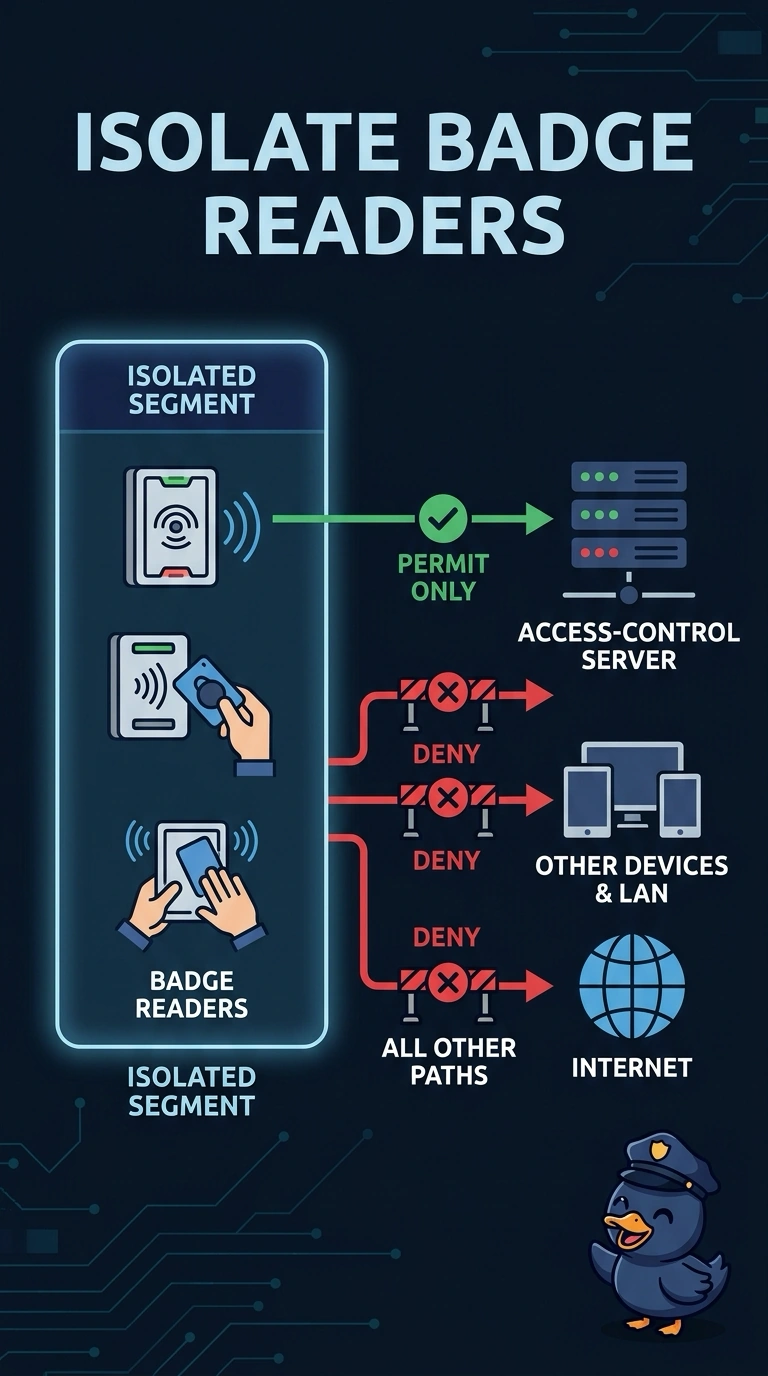
You would not hang a door reader on the guest-lounge line. You put the readers on a segment that talks only to the access-control server. Guest wireless with internet, the staff network, or a laptop firewall they cannot run leaves them in the wrong place.
Full Explanation
The readers speak to one server and cannot run the controls a laptop can run. A segment that allows only that server, and denies the staff network and the internet, matches the conversation the devices actually have. A public route, a seat on the staff network, or a laptop profile they cannot execute leaves them beside systems they should not meet. A device segment that permits the readers only to the access-control server and denies other paths is the design that meets this requirement. Guest wireless with a public route so the vendor can reach each reader from the internet is the wrong fit because a public route on guest wireless exposes devices that only need a local server and cannot defend themselves. The staff network beside point-of-sale terminals, with no extra restriction on the readers is the wrong fit because the staff network is the flat placement that lets point-of-sale systems browse the readers. A laptop firewall profile pushed to readers that have nowhere to install or run it is the wrong fit because a laptop firewall profile has nowhere to run on a badge reader that cannot host a user agent. Exam caveat: Confirm with venue operations before a rule can drop a reader during a gate opening. The allow rule must include the server port the readers use when the gates are live. Operational check: From a point-of-sale terminal, confirm a reader address does not answer, and from the reader segment confirm only the access-control server port succeeds.