
Grocery supervisors share one break-room phone and sign in to scheduling with text codes and with questions the whole shift knows. Which sign-in design replaces that?
Select an answer to reveal the explanation.
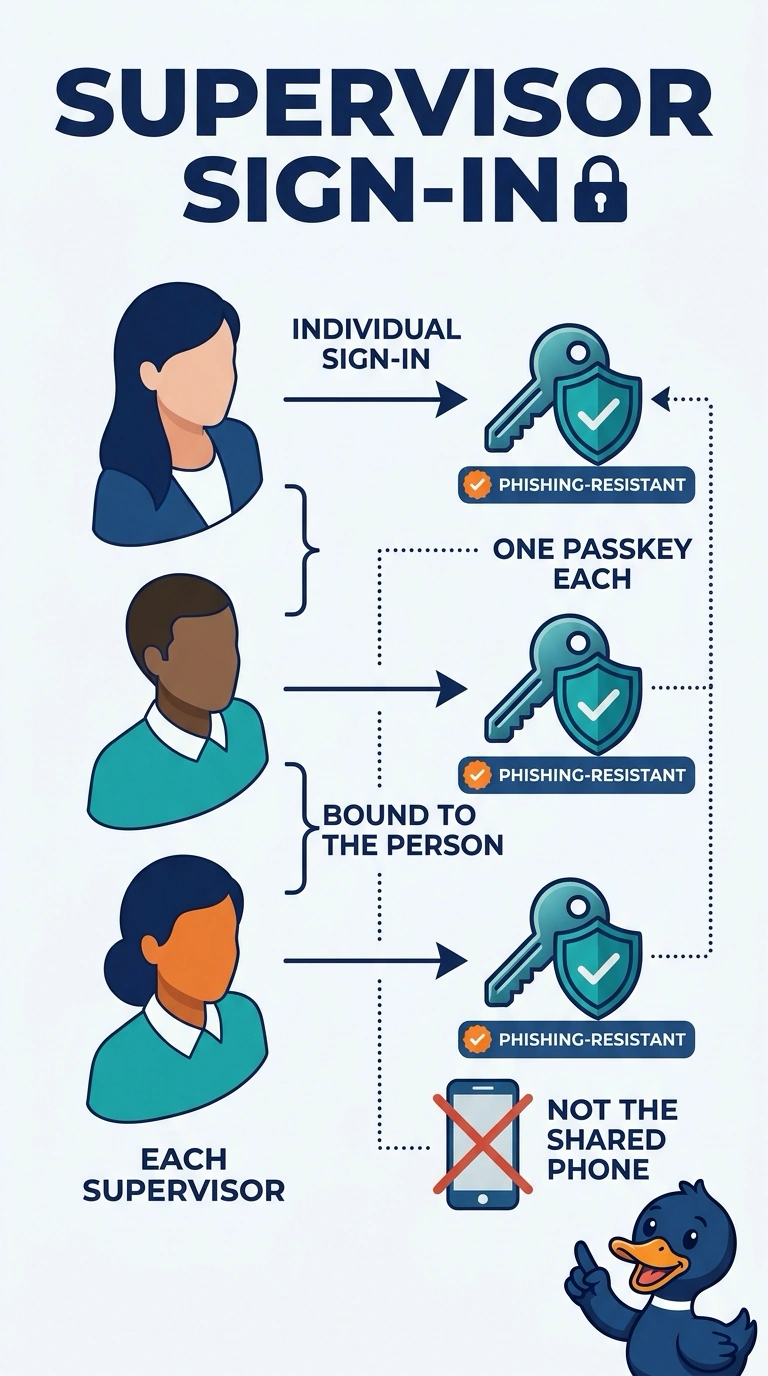
Short Explanation
A code read aloud in a break room is not a secret that belongs to you alone. You give each grocery supervisor a phishing-resistant passkey bound to that person. Text codes to the shared phone, questions the whole shift knows, or a clipboard password stay shared and easy to relay.
Full Explanation
The current secrets are shared and can be relayed: one phone, questions coworkers know, or a password on a clipboard. An individual passkey is phishing-resistant and bound to that supervisor, so a bystander cannot read a code and a fake page cannot reuse a typed secret. Keeping text codes, lengthening known questions, or posting one password leaves the shared secret in place. An individual phishing-resistant passkey for each supervisor, bound to that person rather than the shared phone is the design that meets this requirement. Text codes that continue to arrive on the break-room phone for whoever is standing there is the wrong fit because codes sent to a shared phone can be read by anyone nearby and can be relayed during the sign-in. Longer security questions whose answers are still known to everyone on that shift is the wrong fit because questions the shift already knows are not a secret and are not resistant to a prompted sign-in. One shared password written on the scheduling clipboard beside the terminal is the wrong fit because a clipboard password is shared, typed, and reusable by anyone who can see the scheduling board. Exam caveat: A passkey stops the relay of a text code, and a lost authenticator still has to be revoked the day it is lost so a former supervisor cannot keep using it. Operational check: On a lab scheduling page, confirm one supervisor passkey completes sign-in and a text code to the break-room phone is no longer accepted for that account.