
A university saw a lab router, attached by a student, become a peer and inject a default route. The routing protocol accepts any neighbor on the campus network. Which control protects the control plane?
Select an answer to reveal the explanation.
Short Explanation
Anyone who can shout the right hello is being treated as a fellow driver. You require routing peers to authenticate. A video filter, a larger buffer, or a mail sandbox never checks that hello.
Full Explanation
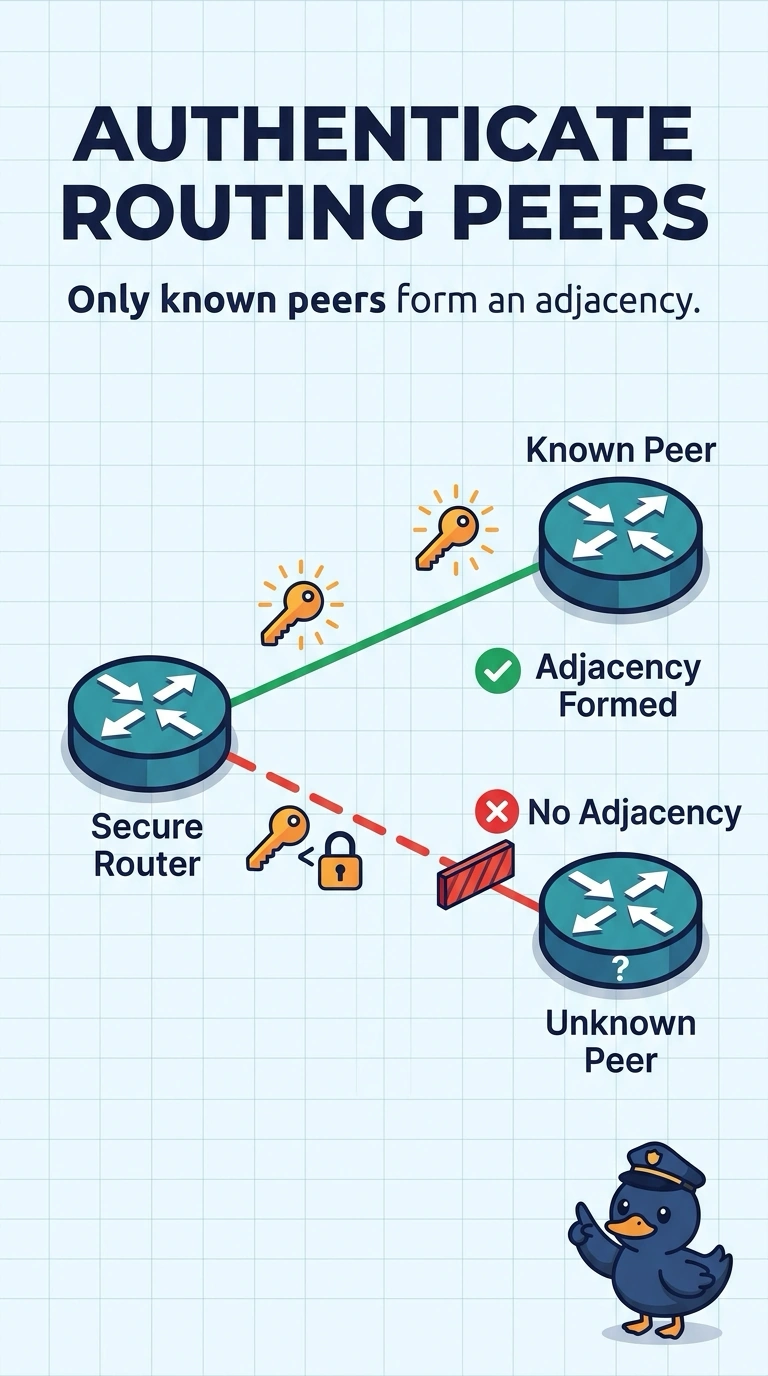
The control plane accepted a neighbor because the protocol had no authentication. Requiring peers to authenticate stops a student router from forming an adjacency and injecting a default. Web policy, a larger buffer, and mail sandboxing do not participate in neighbor formation. Management access and route authentication are different controls; this incident is specifically a rogue peer. Authentication on the routing protocol so only known peers form an adjacency is the design that meets this requirement. A web filter that blocks video on the student wireless network is the wrong fit because video policy does not decide which routers are allowed to exchange routes. A larger data-plane buffer on the core, with neighbors still unauthenticated is the wrong fit because a bigger buffer carries the injected route faster and does not require the peer to authenticate. An email sandbox for student mail is the wrong fit because mail inspection does not protect routing adjacencies. Exam caveat: Authentication does not stop a stolen key on a real peer. Protect the key material and limit which interfaces may form adjacencies at all. Operational check: On a lab segment, bring up an unauthenticated neighbor and confirm the adjacency is refused, then confirm a keyed peer still installs routes.