
A grocery chain has broadband and a provider MPLS circuit at each store. Point-of-sale traffic must prefer the MPLS circuit, and guest wireless may use broadband. The stores also need the choice to move when a circuit fails. Which tunneling approach fits?
Select an answer to reveal the explanation.
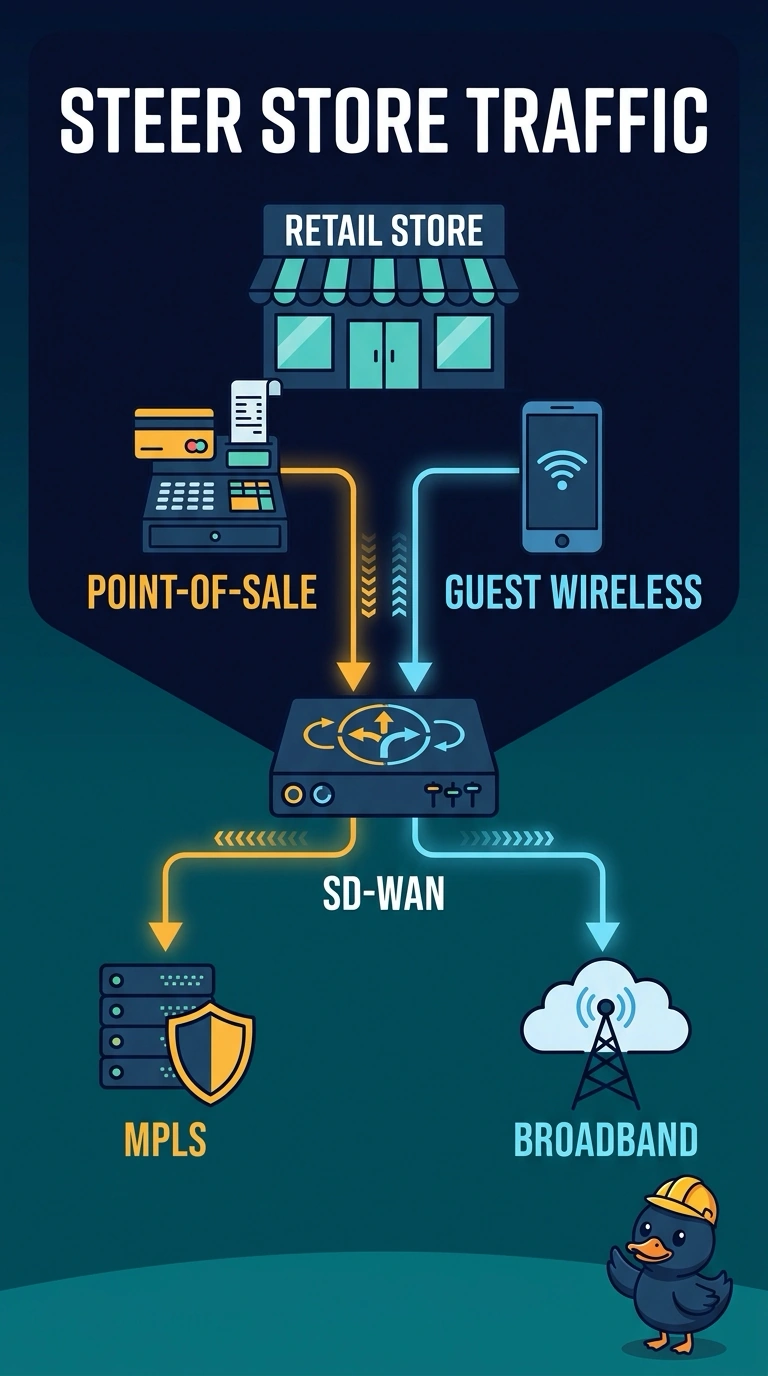
Short Explanation
Two roads into town are useful only if the registers can take the private one and the guests can take the other. You steer with SD-WAN and you fail over when a road closes. Plain GRE, a broadband-only default, or one shared IPsec path makes both kinds of traffic share a single choice.
Full Explanation
The business requirement is per-application preference across two transports, plus failover. SD-WAN policy can mark point-of-sale for the MPLS circuit, mark guest wireless for broadband, and move a class when its circuit fails. GRE is an encapsulation without that steering. One default route and one shared IPsec path collapse both applications onto a single choice. SD-WAN that steers point-of-sale onto MPLS and guest wireless onto broadband is the design that meets this requirement. A GRE tunnel that encapsulates both applications with no encryption and no steering is the wrong fit because GRE wraps packets and does not choose a transport per application or move them when a circuit fails. A single default route toward broadband with MPLS left unused is the wrong fit because a single default toward broadband ignores the requirement to prefer MPLS for point-of-sale. A hub-and-spoke IPsec mesh that sends guest wireless and point-of-sale on the same path is the wrong fit because one IPsec path for every application cannot prefer MPLS for the registers and broadband for guests. Exam caveat: Steering is not encryption. If the grocery chain also requires confidentiality on broadband, add encryption to that transport rather than assuming the steering policy provides it. Operational check: Fail the MPLS circuit in a lab store and confirm point-of-sale moves, and confirm guest wireless stays on broadband while both circuits are up.