
An accounting firm issues sessions that last all day. A laptop can be patched and encrypted at 8 a.m. and have encryption turned off by noon, and the session stays open. Which identity design fixes that?
Select an answer to reveal the explanation.
Short Explanation
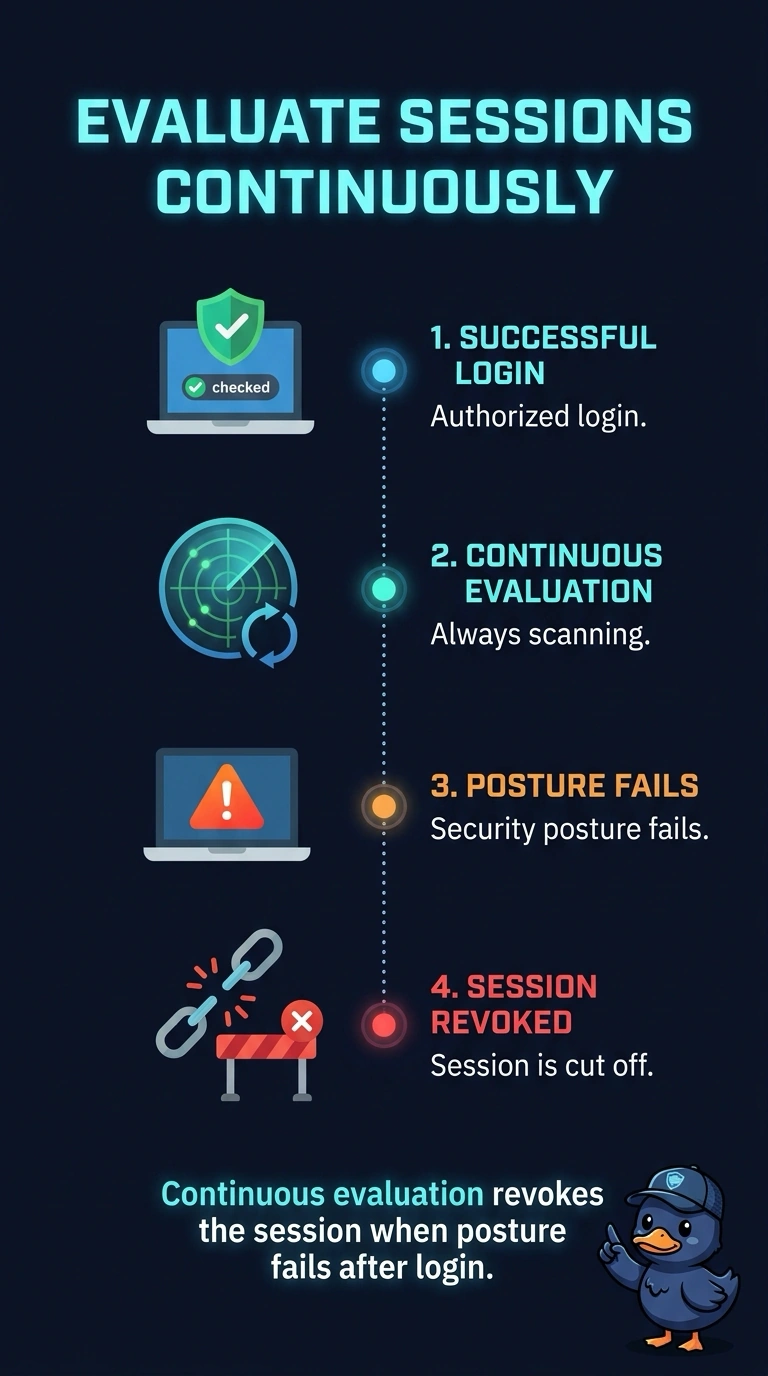
A badge checked only at the front door stays valid after someone props the side door open. You recheck the laptop during the day and you revoke the session when encryption drops. A morning-only check, a password calendar, or a lobby kiosk misses noon.
Full Explanation
Identity here is not a one-time gate. The requirement is to notice that a live session's device stopped meeting the bar. Continuous evaluation rechecks posture and revokes the session when encryption is off, instead of waiting for tomorrow's login. A longer password cycle and a kiosk policy do not watch this laptop. Continuous evaluation that revokes the session when posture fails after login is the design that meets this requirement. A single check at the first login, with no further look until the next day is the wrong fit because the morning check is what the firm already does, and it misses the noon change. A password change every 30 days and no view of device posture at all is the wrong fit because password age does not tell the firm that encryption was turned off on a live session. A lobby kiosk session that is unrelated to the accountant's laptop is the wrong fit because the kiosk is not the laptop whose posture changed. Exam caveat: Revocation has to reach the application, not only the identity provider's logs. A token the application never rechecks will keep working until it expires. Operational check: On a lab laptop, pass the morning check, disable encryption, and confirm the open application session is revoked without waiting for the token's original lifetime.