
A pharmacy chain runs an ordering application with the web tier in one public cloud, the API in a second public cloud, and the inventory database in its data center. Each site has an edge firewall. Packet captures show the API calls crossing the internet in the clear. Which design fixes the gap?
Select an answer to reveal the explanation.
Short Explanation
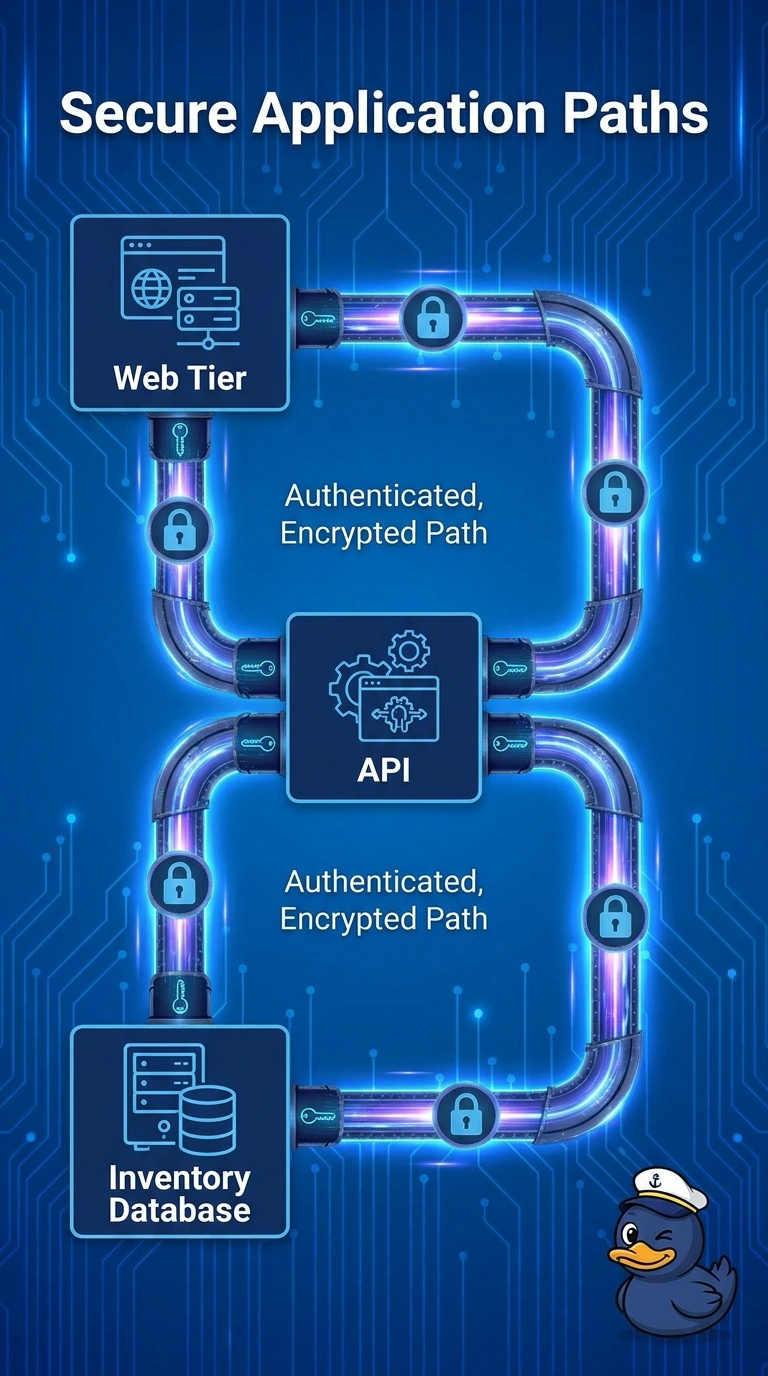
Three buildings with good front doors can still shout across the street. You authenticate and encrypt the calls between web, API, and inventory. A browsing filter, the same edge boxes with no new path protection, or a flat database route leaves the shout in the clear or makes it louder.
Full Explanation
The application is one system spread across three places. Edge firewalls at each place do not automatically protect the calls between places, and the captures show those calls are plaintext. The design needs the tiers to authenticate to each other and to encrypt that path, whether the transport is a private interconnect or an encrypted tunnel, and it needs the database to stay reachable only by the API. A browsing filter and a flat database route solve other problems. Authenticated, encrypted paths between the web tier, the API, and the inventory database is the design that meets this requirement. A stricter outbound web filter on the data-center edge for employee browsing is the wrong fit because employee browsing is not the flow that is crossing the internet in the clear between the tiers. Independent edge firewalls with no inspection or encryption on the path between the tiers is the wrong fit because the edge firewalls are already there and the captures show they are not protecting the tier-to-tier calls. A single flat network that routes the database subnet into both public clouds is the wrong fit because extending the database subnet into both clouds widens reach and does not encrypt the calls. Exam caveat: Encryption between tiers does not replace authorization at the API. A stolen API credential can still request inventory over a perfectly encrypted path. Operational check: Capture a new API call and confirm it is encrypted in transit, and confirm the web tier cannot open a direct session to the inventory database.