
A payment processor's domain administrators use the same laptop for email, browsing, and changes to the identity platform. Malware from a mail attachment has reached that platform twice. Which endpoint design separates administration?
Select an answer to reveal the explanation.
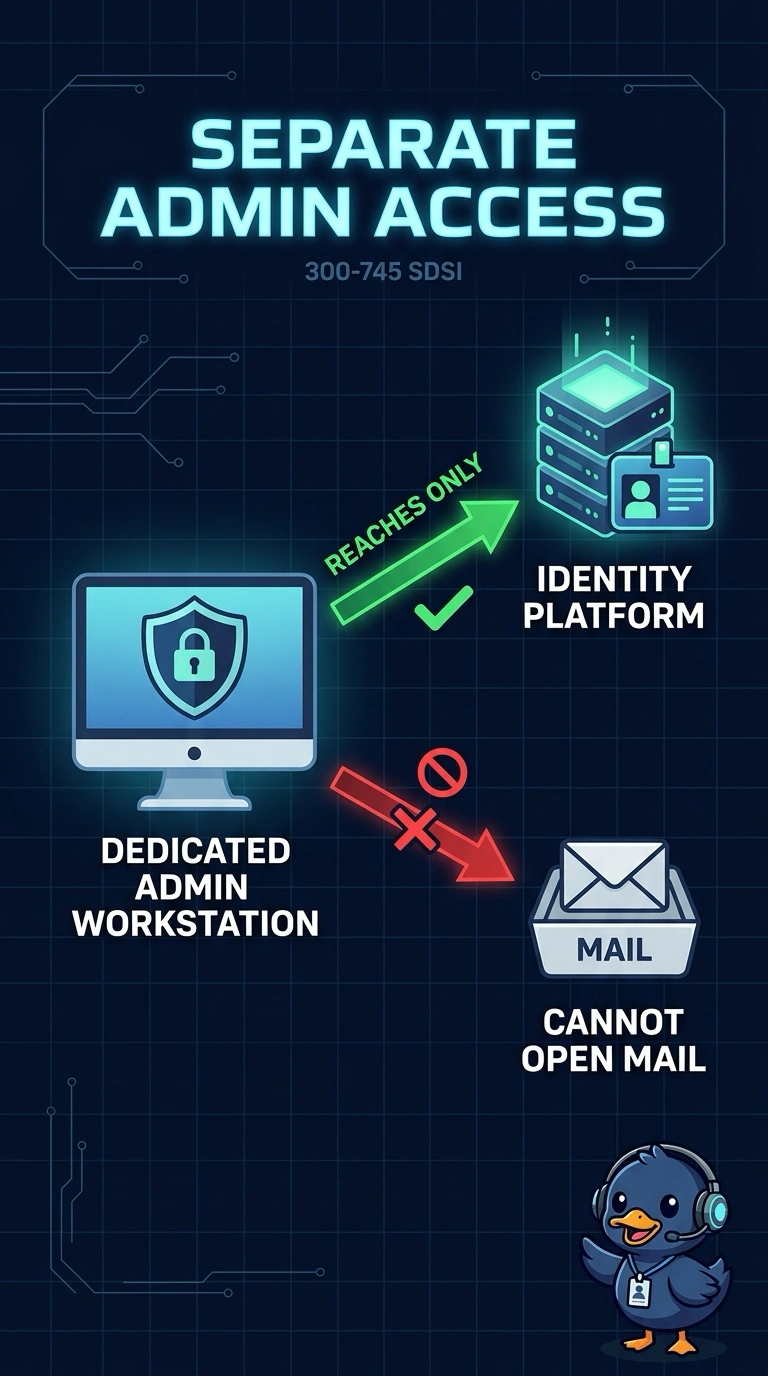
Short Explanation
You do not sign checks at the same desk where you open junk mail. You give administrators a workstation that reaches only the identity platform and you take mail off it. A faster daily laptop, a spam filter, or vendor wireless keeps the checkbook on the junk-mail desk.
Full Explanation
The endpoint that can change identity is also the endpoint that opens untrusted mail, so one attachment becomes an administrative session. A dedicated workstation that reaches only the identity platform, and that has no mail client, breaks that chain. The daily laptop keeps the mail. Faster hardware, a filter that still allows the combo, and a guest network leave administration on the exposed machine. A dedicated admin workstation that can reach only the identity platform and cannot open mail is the design that meets this requirement. A faster laptop for the same person, still used for mail and for administration is the wrong fit because speed does not remove mail and browsing from the machine that can change the identity platform. A spam filter that leaves administration on the daily laptop is the wrong fit because a spam filter reduces one feed and still leaves administration on the laptop that opens mail. A guest network for vendors, with administrators unchanged is the wrong fit because vendor wireless was not the path the attachment used to reach the identity platform. Exam caveat: The dedicated workstation still needs its own patching and its own phishing-resistant sign-in. Separation is not a reason to skip those. Operational check: From the daily laptop, confirm the identity platform's admin port is unreachable, and from the admin workstation confirm mail hosts do not resolve.