
A water utility's edge routers have been dropping routing adjacencies when a spike of management scans hits their addresses. Operators still need SSH from a known bastion. Which approach protects the management and control planes?
Select an answer to reveal the explanation.
Short Explanation
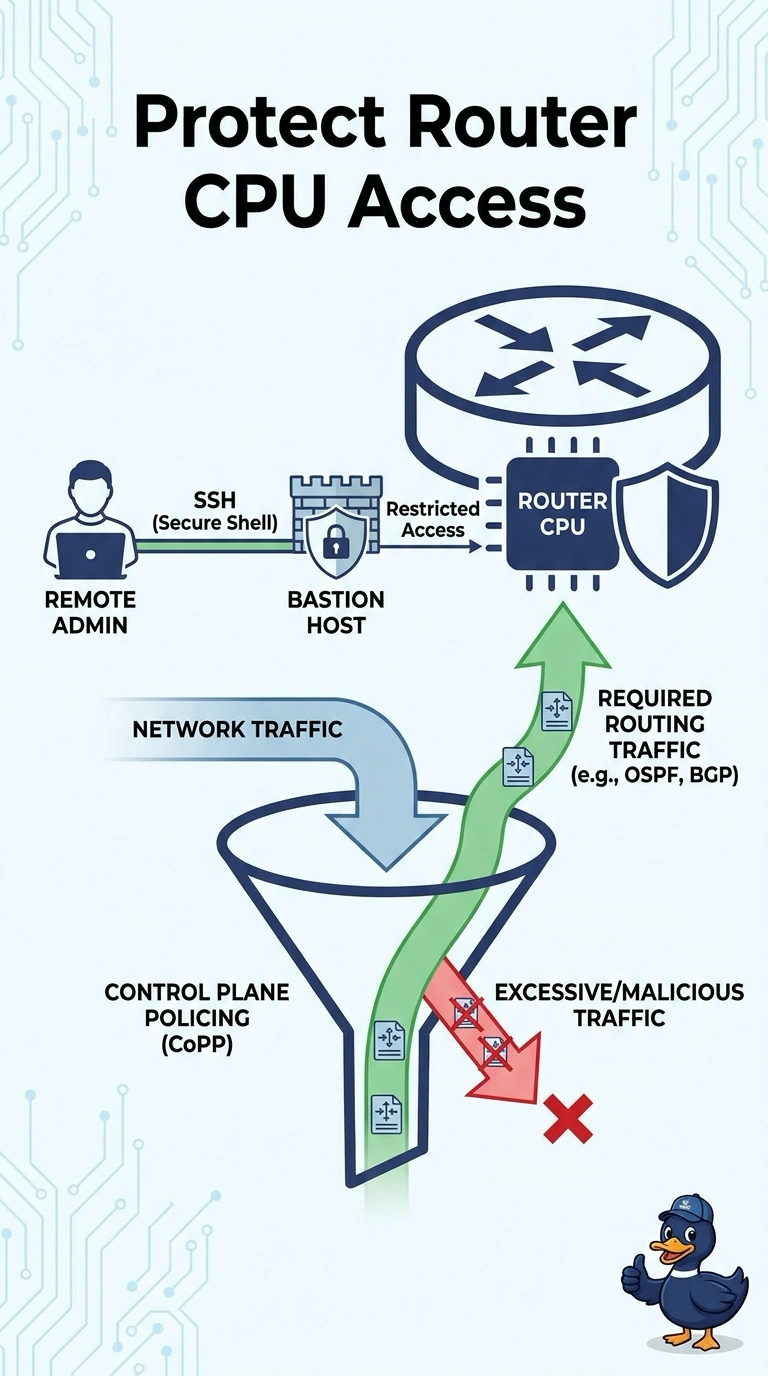
The router is the clerk, and when strangers crowd that desk the routing conversation stops. You allow management only from the bastion and you reserve CPU for routing. A user web filter, an open permit, or a larger forwarding table never protects that desk.
Full Explanation
Packets to the router, not through it, are what exhausted the control plane and dropped adjacencies. The design separates management: Restrict SSH to the bastion and use control-plane policing to limit traffic punted to the CPU while allowing required routing traffic. A web filter on users, an open internet permit, and a bigger forwarding table never classify traffic destined to the router. Restrict SSH to the bastion and use control-plane policing to limit traffic punted to the CPU while allowing required routing traffic is the design that meets this requirement. A user web filter that blocks social media on the employee VLAN is the wrong fit because employee web policy does not limit who can open sessions to the router's own addresses. An open permit of every protocol to the router's own addresses from the internet is the wrong fit because an internet permit is the exposure that let the scans reach the router CPU. A larger forwarding table so data-plane routes install faster is the wrong fit because the forwarding table serves data-plane routes and does not police packets aimed at the router itself. Exam caveat: A policer limits offered traffic to the control plane; verify the routing class under load. Operational check: From outside the bastion, confirm SSH to the router fails, and during a lab scan confirm the routing adjacency stays up.