
A school district's teachers use district laptops on home networks that the schools do not operate. Student-record applications must refuse a laptop whose disk encryption is off or whose operating system is behind on patches. Which design enforces that requirement?
Select an answer to reveal the explanation.
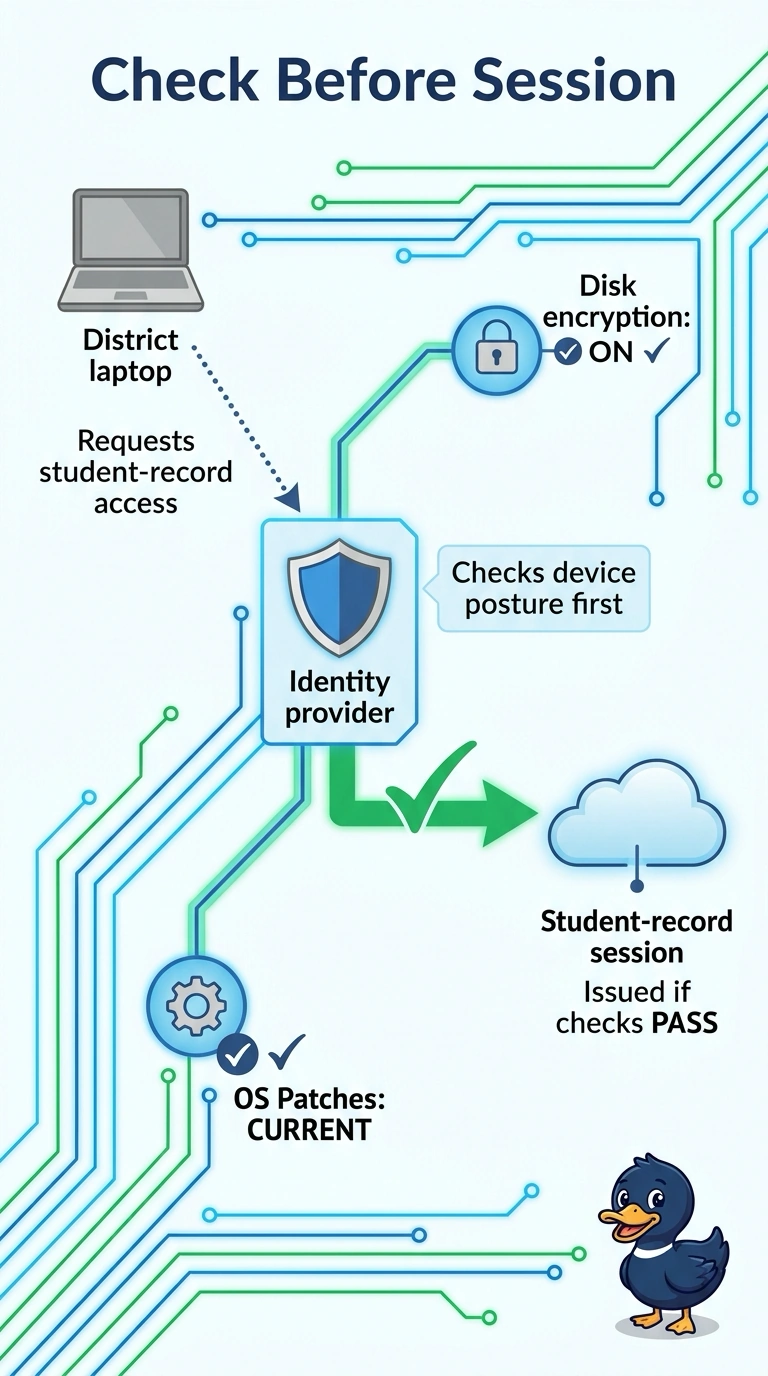
Short Explanation
A laptop on a kitchen table is outside every switch you own, so the lock has to ride along with the login. You check encryption and patch level in the identity provider before the session opens. A VPN tunnel, a campus VLAN filter, or the email gateway never measures a machine that stays at home.
Full Explanation
Teachers authenticate from networks the district does not control, so the decision has to sit on the sign-in path rather than on a campus switch. The identity provider can read the device-management signal for disk encryption and patch level and withhold the session when either signal fails. That binds the requirement to every login, including logins that never hairpin through a school firewall. A posture check in the identity provider before the student-record session is issued is the design that meets this requirement. Trust in any district laptop that brings up a tunnel to the school VPN concentrator is the wrong fit because a tunnel only proves the laptop reached the concentrator, not that encryption and patches are healthy. A stateful filter on the campus core that watches only the teacher VLAN is the wrong fit because home sessions never cross the campus teacher VLAN, so that filter cannot see them. Attachment scanning at the district email gateway with no check of the laptop is the wrong fit because mail scanning looks for bad attachments and never measures disk encryption or patch level. Exam caveat: A posture result is only as fresh as the last check-in from the device service, so a laptop that has not reported recently should be treated as unknown rather than healthy. Operational check: From a test laptop, turn disk encryption off, request the student-record application, and confirm the identity provider denies the session and logs the failed posture rule.