
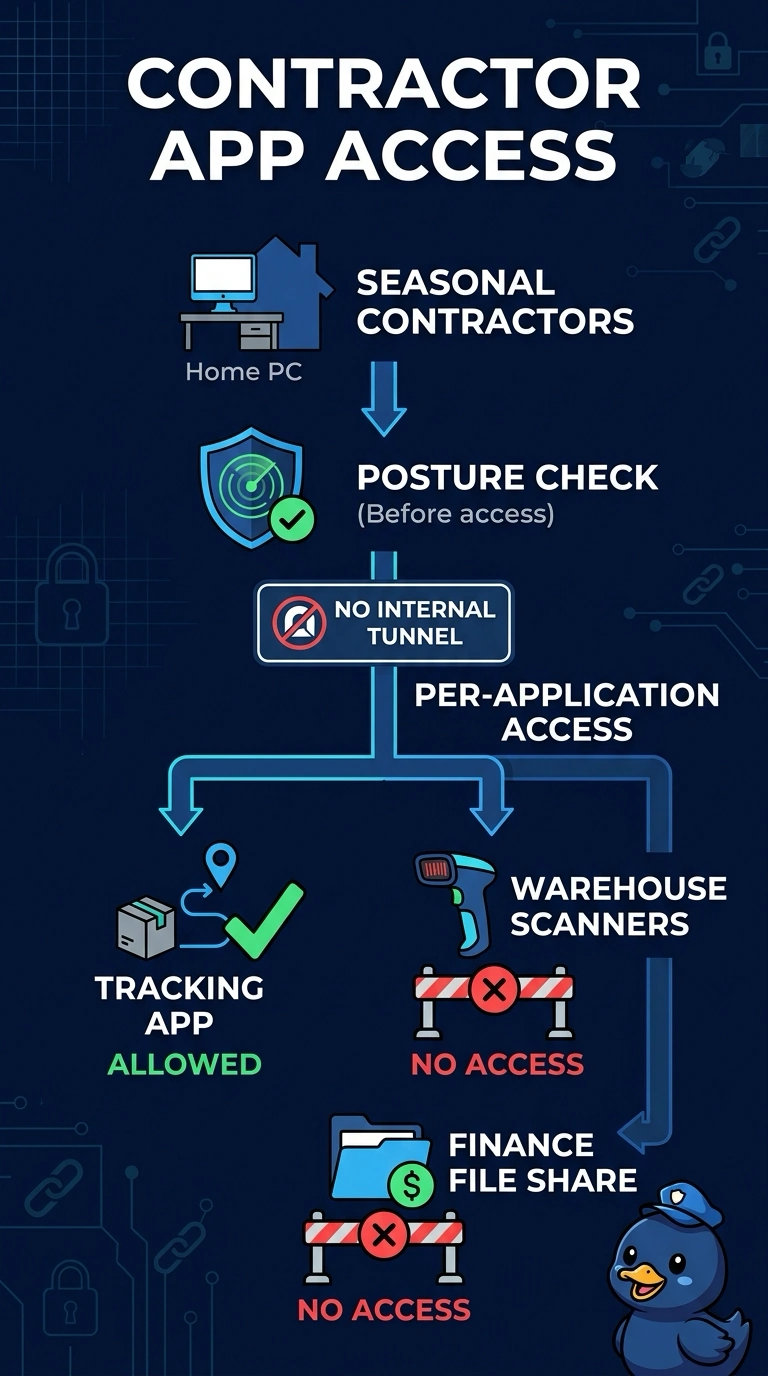
A logistics company hires seasonal contractors who need one shipment-tracking application from unmanaged home PCs. They must not reach the warehouse scanners or the finance file share. Which architecture fits those hybrid workers?
Select an answer to reveal the explanation.
Short Explanation
You would not give a seasonal driver a master key because they need one loading dock. You open the tracking application and you leave the warehouse network off their PC. A full tunnel, a home-router site-to-site, or a split tunnel that includes finance hands them the master key.
Full Explanation
The requirement is one application for a user on a PC the company does not own. Per-application access publishes tracking after a posture check and does not route the warehouse or finance networks to that PC. A tunnel that lands the PC inside the warehouse network solves a different problem: an employee who must administer internal systems. Per-application access to tracking, gated by a posture check, with no internal tunnel is the design that meets this requirement. A full-tunnel VPN that places the home PC on the warehouse network is the wrong fit because a full tunnel puts an unmanaged PC on the same network as scanners and finance, which the requirement forbids. A site-to-site tunnel from the contractor's home router into the data center is the wrong fit because a site-to-site tunnel from a home router extends the data center to a network the company does not manage. A persistent split tunnel that also routes finance and scanner subnets to the home PC is the wrong fit because routing finance and scanner subnets is the access the design was told to withhold. Exam caveat: Unmanaged PCs still need a minimum posture bar, or the application session is only as safe as a machine the company has never seen. Operational check: From a lab PC that is not company-managed, confirm tracking opens after the posture check and that finance and scanner addresses do not route.