
A hospital's infusion pumps sit on the same VLAN as clinician laptops and can be browsed from those laptops. The pumps only need to reach their vendor controller. Which architecture change fits these devices?
Select an answer to reveal the explanation.
Short Explanation
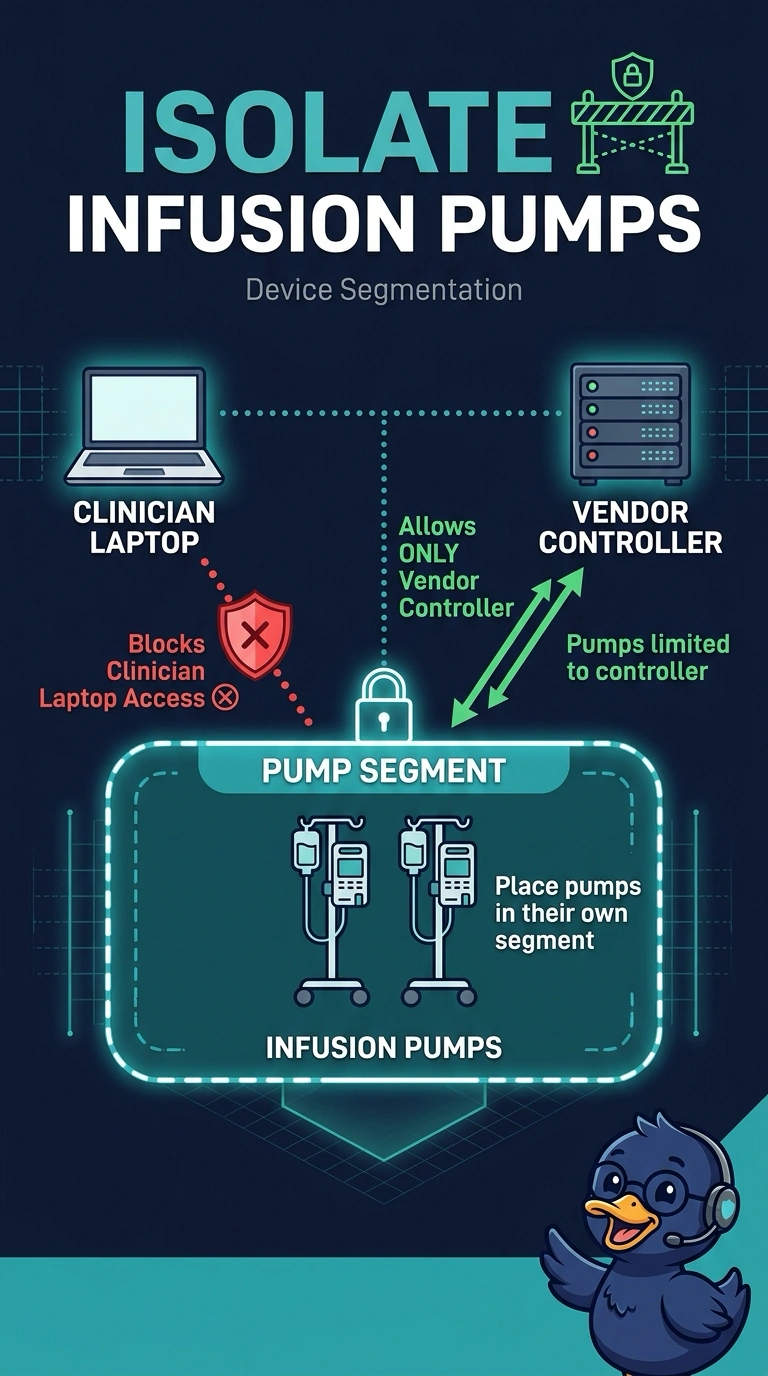
You would not park an IV pole in the middle of the staff office. You give the pumps their own segment and you allow only the controller. A public address, the clinician wireless network, or a laptop firewall profile they cannot run leaves them in the office.
Full Explanation
IoT clinical devices rarely run the controls a laptop can run, and they do not need to be neighbors of email and browsing. A segment dedicated to the pumps, with a path only to the controller and no path from the clinician VLAN, matches how the devices actually communicate. That is the architecture change, not a new management address on the internet. A device segment that allows the pumps only to their controller and blocks laptop access is the design that meets this requirement. A public address on each pump so the vendor can manage it from the internet is the wrong fit because a public address on a pump increases exposure and is not required for a controller the hospital can place internally. The same wireless network clinicians use for email, with no extra filter is the wrong fit because the clinician wireless network is the flat placement the incident risk already describes. A host firewall profile designed for laptops, pushed to pumps that cannot run it is the wrong fit because a laptop firewall profile does not install on a pump that has no interactive user agent and no place to run it. Exam caveat: Clinical devices can be safety systems. Confirm with clinical engineering before a rule can drop a session the pump needs to stay in service. Operational check: From a clinician laptop, confirm the pump address no longer answers, and from the pump segment confirm only the controller port succeeds.