
A research lab records a badge denial at the door and, the same minute, a successful VPN login for that researcher from another country. Each event is already stored. What does the team still need?
Select an answer to reveal the explanation.
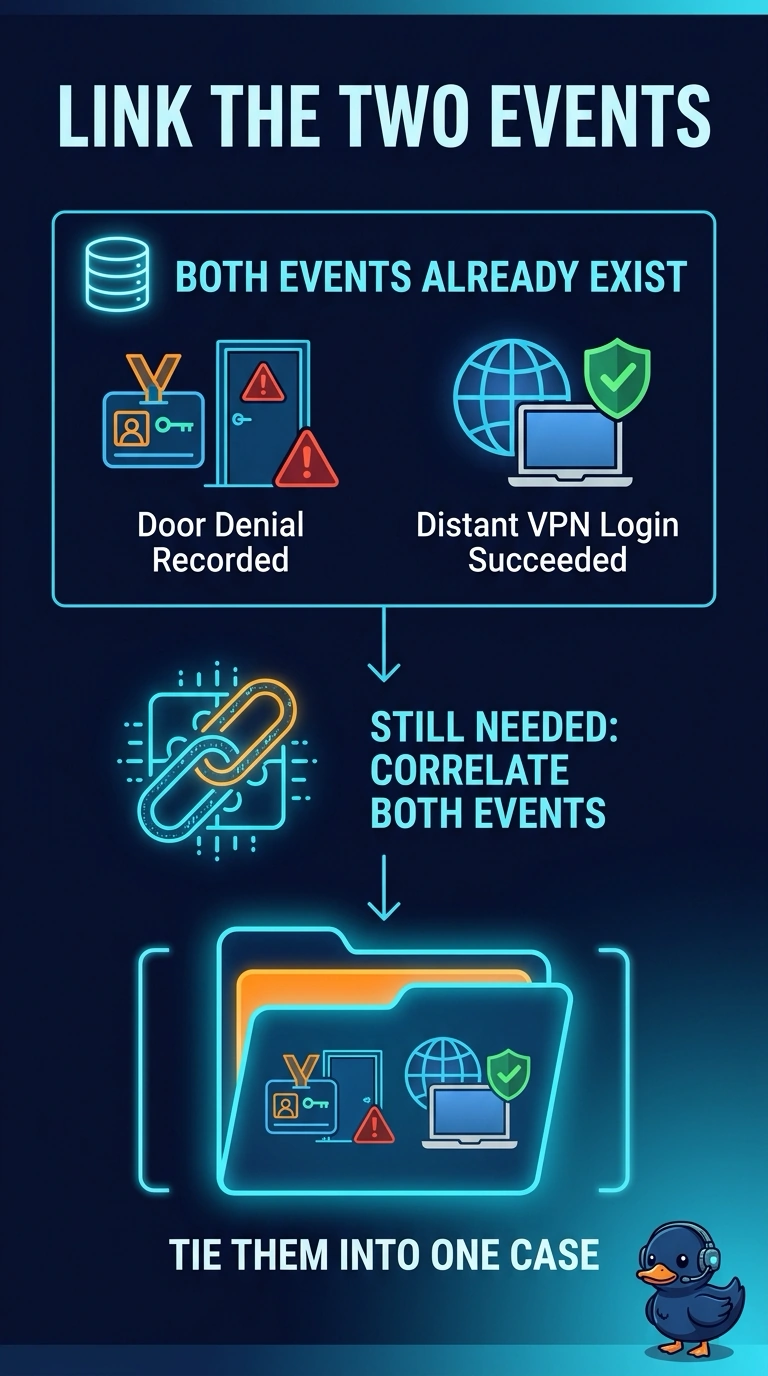
Short Explanation
Two footprints in different countries are one story only if you lay them side by side. You correlate the badge denial and the distant login into a single case. A wall tile, a malware-hash feed, or a playbook that isolates every laptop skips that link.
Full Explanation
The team already has both records, and what they lack is a join: the denied badge and the distant login share a person and a minute. Correlate the same-minute events using a verified identity and examine the VPN origin before attributing both to one incident. A wall tile, a hash feed, and a playbook that isolates every machine do not establish the relationship those two records are waiting on. Correlation that ties the badge denial and the distant VPN login into one case is the design that meets this requirement. A dashboard tile that shows the same two events on a wall and starts no investigation is the wrong fit because a tile repeats events the team can already see and does not build one case from the related pair. A malware-hash feed that adds no link between the door event and the VPN login is the wrong fit because a hash feed enriches files with malware context and does not join a door event to a VPN login. A playbook that isolates every lab laptop before anyone asks if the events are related is the wrong fit because isolating every laptop is a response that skips the question of whether these two events are one incident. Exam caveat: Correlation builds the case and does not contain the session, so a person or a separate playbook still has to decide what to do with the VPN login. Operational check: Replay a lab badge denial and a same-minute distant VPN success for one test account and confirm the tooling opens one case that cites both events.