
A community college registrar stores grades and class enrollment for its students and does not run a clinic or take card payments. Which document should those security requirements match?
Select an answer to reveal the explanation.
Short Explanation
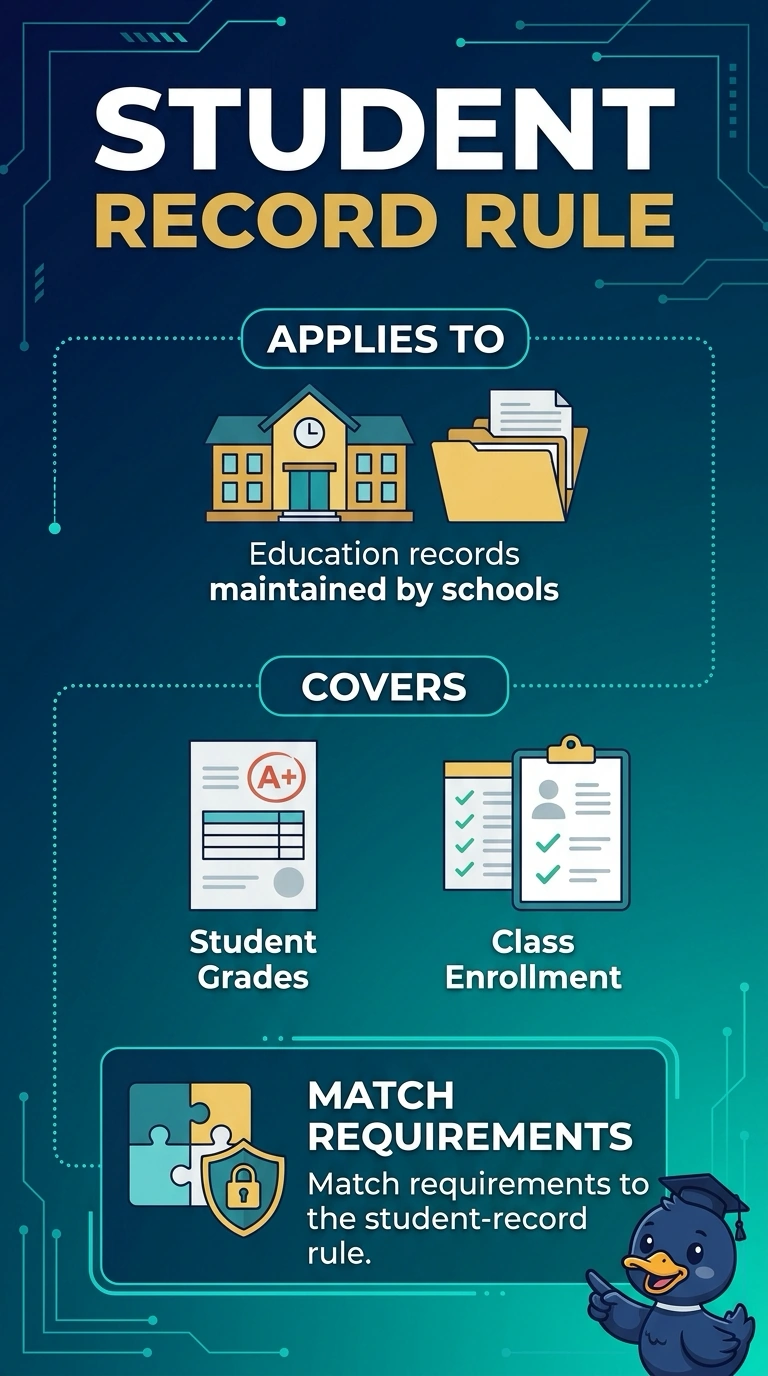
You match the folder to the school, not to the hospital next door. Grades and enrollment at the college belong to the student-record rule. The health-information rule, the payment-card standard, and federal cloud authorization govern different systems.
Full Explanation
Grades and enrollment maintained by a school are education records, and the document that matches them is the student-record rule. Health-information, payment-card, and federal-cloud documents match a clinic, a merchant, and a cloud service sold to an agency. The registrar is none of those, so the task is to match the document and not to give the college legal advice. The student-record rule that applies to education records maintained by a school is the design that meets this requirement. The health-information rule that applies to patient charts maintained by a clinic is the wrong fit because health-information rules cover patient care records at a clinic, and a registrar is not a clinic. The payment-card standard that applies to merchants storing cardholder data is the wrong fit because payment-card rules cover cardholder data at a merchant, and this registrar does not take card payments. The federal cloud authorization program for services sold to civilian agencies is the wrong fit because federal cloud authorization covers services sold to civilian agencies, not a college registrar. Exam caveat: A college that also runs a clinic or sells a cloud service to an agency can have more than one document in scope. This question is only the registrar. Operational check: List the systems that store grades and enrollment and confirm they, not the campus clinic if one is added later, are matched to the student-record document.