
A warehouse attacker used one shared jump-host login to alter shipping labels, and the team restored a clean image that still has that shared login. Which redesign follows from the incident?
Select an answer to reveal the explanation.
Short Explanation
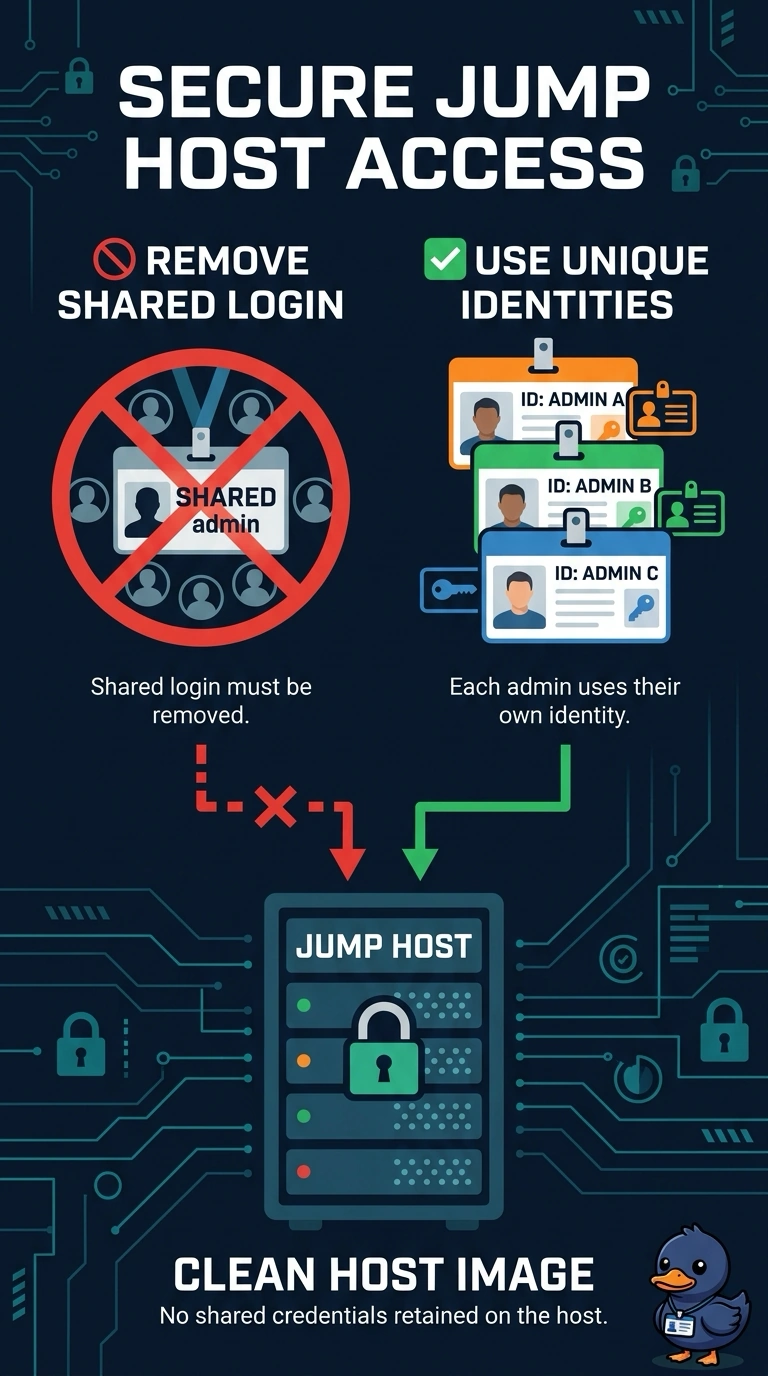
A shared key under the doormat is still shared after you hang a clean door. You give each administrator a separate jump-host identity and you remove the shared login. Another restore, floor wireless, or a longer shared password leaves that same login in place.
Full Explanation
The break succeeded because one login represented every administrator, so the stolen secret could not be pinned to a person or revoked for one person. Restoring the image preserves that login for the next shift. Per-person identities let the warehouse disable one person and delete the shared login, which is the design change this incident justifies. Per-person administrator identities on the jump host, with the shared login removed is the design that meets this requirement. A second restore of the same image so the next shift still shares one login is the wrong fit because another restore puts the same shared login back on the path the attacker already used to alter labels. A new wireless network on the warehouse floor that does not reach the jump host is the wrong fit because floor wireless was not the path that changed labels, so the jump host stays shared on the next shift. A longer shared password that every supervisor still types into the same account is the wrong fit because a longer secret on one shared account is still reusable by anyone who learns that one password. Exam caveat: Apply the change to every jump path into the label system, including break-glass accounts, or a second shared login will recreate the path the attacker used. Operational check: After the change, confirm the old shared account cannot sign in, and confirm each supervisor's own identity is the one recorded on a test label change.