
Attackers who compromised one stadium kiosk reused its local administrator password on every other kiosk and spread ransomware. Reimaging put that same password back. Which redesign follows?
Select an answer to reveal the explanation.
Short Explanation
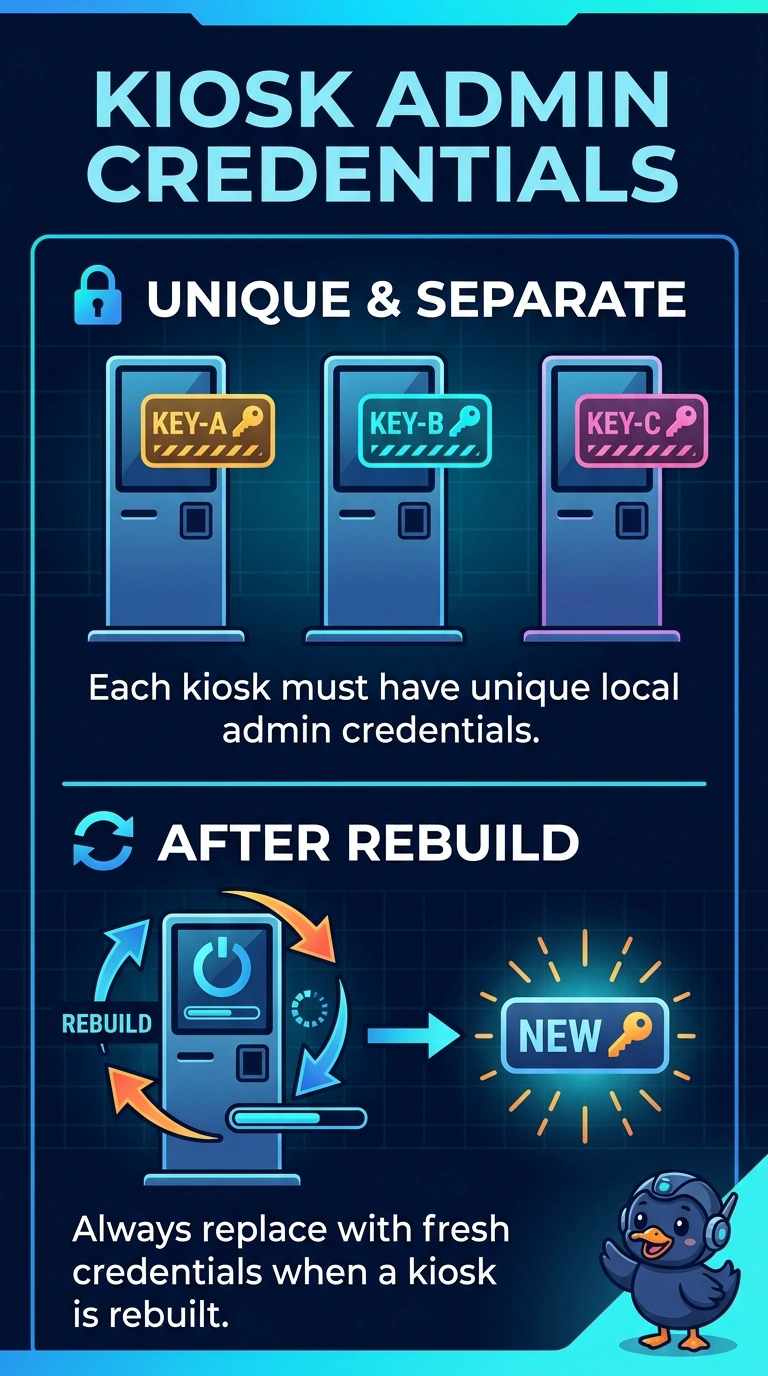
One key that opens every locker is the problem, and cutting new copies of that key repeats it. You give each kiosk its own local administrator credential and you retire it at rebuild. Another shared-password reimage, a mail sandbox, or a guest-wireless change leaves the reused secret in place.
Full Explanation
One local administrator password was valid on every kiosk, which is why one compromised machine spread ransomware to the rest, and reimaging that same secret leaves the path in place. Unique credentials, replaced at each rebuild, stop a password stolen from one kiosk from opening the next. A mail sandbox and a guest-wireless change do not touch the shared local secret the attackers reused. Unique local administrator credentials on each kiosk, replaced again whenever that kiosk is rebuilt is the design that meets this requirement. Another reimage that returns the same shared administrator password to every kiosk is the wrong fit because putting the same password back on every kiosk restores the exact reuse path the attackers walked. A mail sandbox for an intrusion that moved by reusing a local password, not by a new file is the wrong fit because a mail sandbox does not change the local credential that let one compromised kiosk unlock the others. A guest-wireless passphrase change for a network these kiosks do not join is the wrong fit because the guest wireless network was not the path between the kiosks, so a new passphrase leaves that path intact. Exam caveat: Keep each kiosk's current secret outside the machine image, or the next rebuild will copy one shared administrator password back onto every kiosk. Operational check: After a lab rebuild of two kiosks, confirm each local administrator password differs and that the first kiosk's password is rejected on the second.