
A retailer is drawing a branch design and wants a reference for which security capabilities belong on the store flow, from the register to the data center. Which framework is meant for that placement?
Select an answer to reveal the explanation.
Short Explanation
You are asking where to put the cameras along the route, not for a list of burglar tricks or a signature on the occupancy permit. You use the placement reference. An attack catalog, the authorization lifecycle, or a student-record rule answers a different question.
Full Explanation
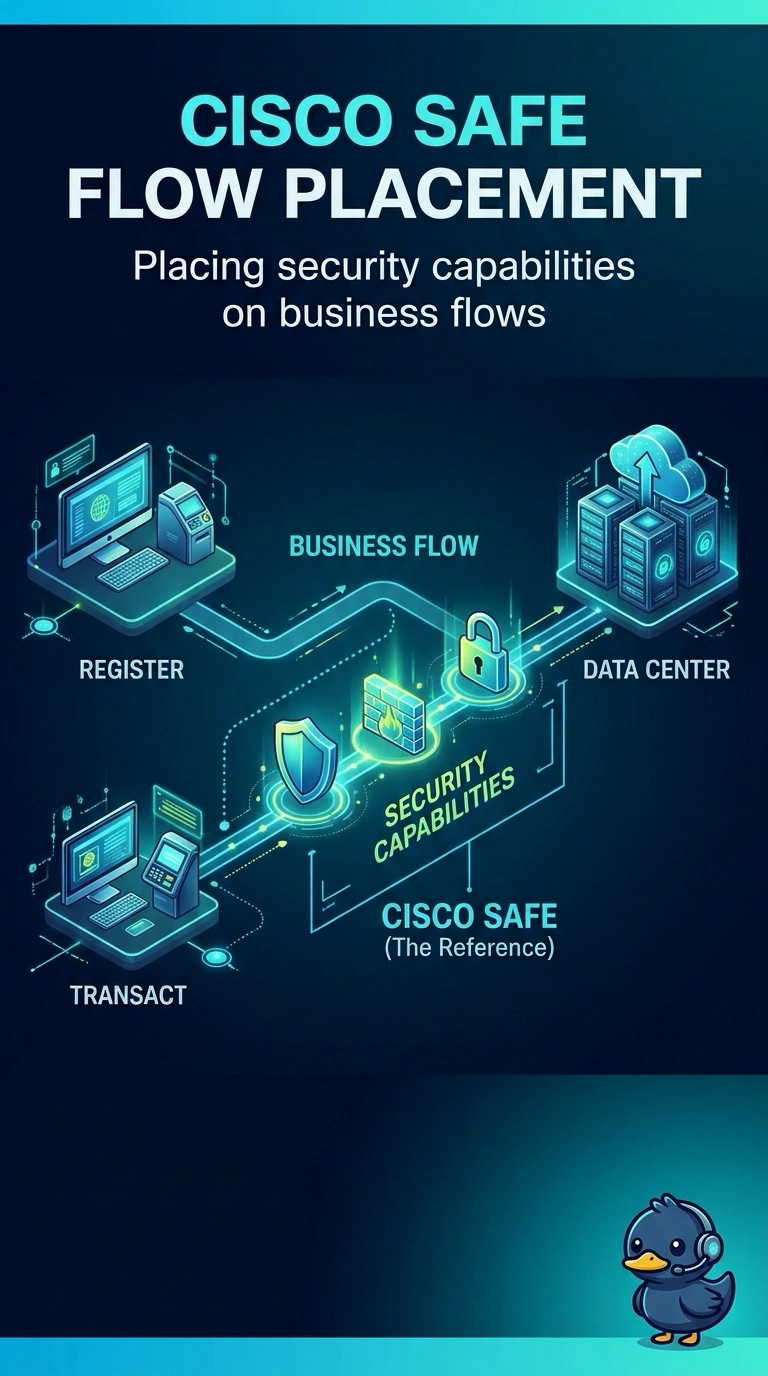
The architect is asking where capabilities go along a business flow. SAFE is Cisco's reference for that kind of placement, across places such as branch and data center, tied to the flow. CAPEC catalogs attack patterns. NIST SP 800-37 is how you authorize a system. A student-record rule is a compliance match for schools. Only the placement reference answers the drawing in front of the team. Cisco SAFE, the reference for placing security capabilities on business flows is the design that meets this requirement. MITRE CAPEC, a catalog of attack patterns is the wrong fit because an attack-pattern catalog tells you how attacks work and does not place capabilities on a store flow. NIST SP 800-37, the lifecycle that authorizes a system to operate is the wrong fit because the authorization lifecycle decides whether a system may operate and is not a placement reference. A student-record rule written for education files is the wrong fit because a student-record rule does not describe where to put capabilities on a retail branch flow. Exam caveat: SAFE is a reference, not a bill of materials. The retailer still has to match each suggested capability to the flow it actually has. Operational check: On the branch diagram, point each SAFE capability the team adopts at a specific place on the register-to-data-center flow and note any capability with nowhere to sit.