
A concert venue's mesh allows only the box-office identity to call payments, but pods whose proxy failed still reach payments directly. Which control closes that bypass?
Select an answer to reveal the explanation.
Short Explanation
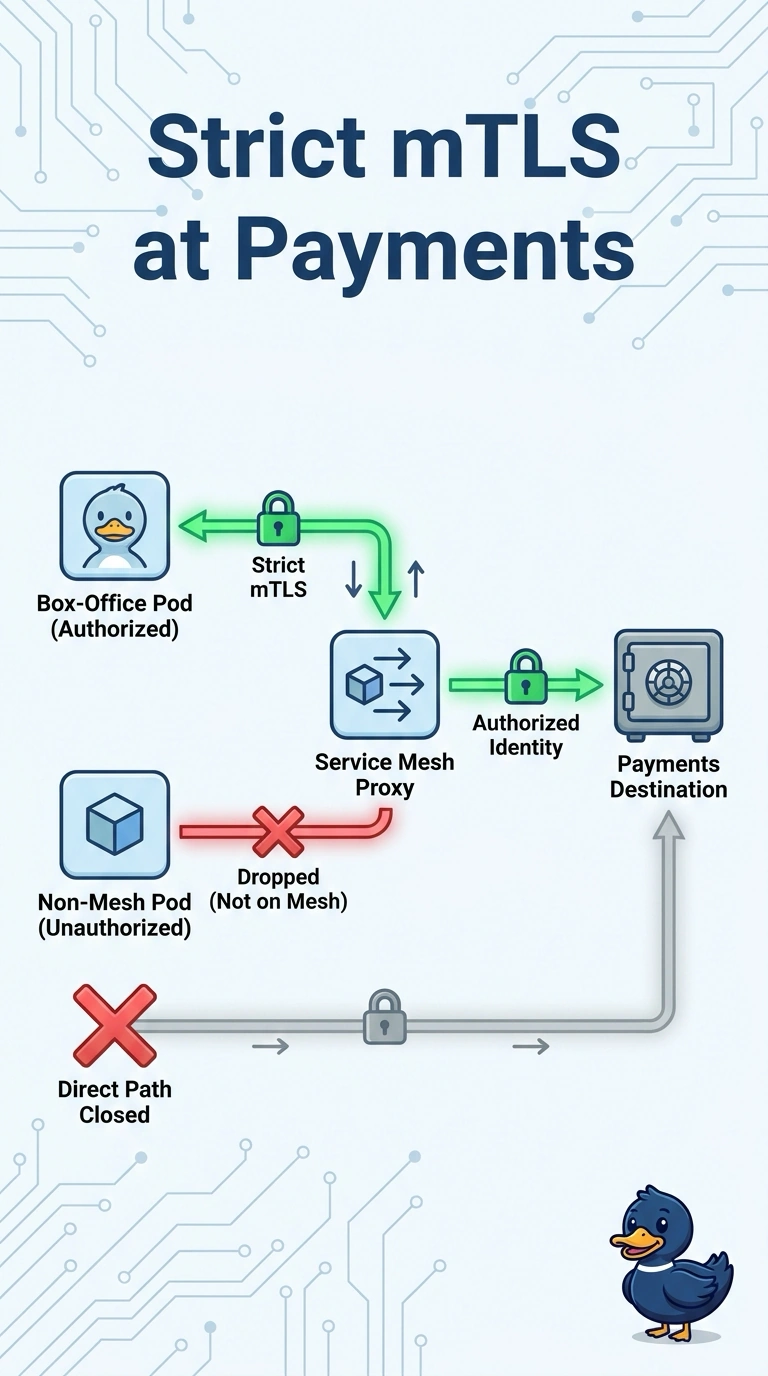
A locked side door does not help if the loading dock is open. You require strict mutual TLS and authorize the box-office identity at the payments destination, with the direct path closed, so a missing proxy fails closed. More proxy CPU, a perimeter firewall, or a node security group leaves that direct path.
Full Explanation
The identity rule lives in the proxy, so a pod whose proxy is missing can call payments on a direct plaintext path that skips the rule. Require strict mutual TLS and authorize the box-office identity at the payments destination, with the direct path closed, so only a verified box-office identity can connect and unauthenticated traffic fails closed. A larger CPU limit on the proxy that still allows a pod with no proxy at all is the wrong fit because more proxy CPU does not stop a proxyless pod from calling payments directly. A perimeter firewall that does not see the payment calls inside this cluster is the wrong fit because it sits outside the cluster and never sees the bypass inside the worker. A node security group that can see only the shared worker address of the host is the wrong fit because it cannot tell a proxyless pod from the box office when they share one address. Exam caveat: Test a legitimate box-office pod with its proxy in place, or a strict rule that is too broad will also drop real sales. Operational check: Stop the proxy on a lab pod and confirm its payment call is dropped, then restore the proxy and confirm the box-office sale succeeds.