
A pharmacy chain runs prescription-filling pods and a public menu pod on one cluster. Today any pod can reach any other pod. Which segmentation fits?
Select an answer to reveal the explanation.
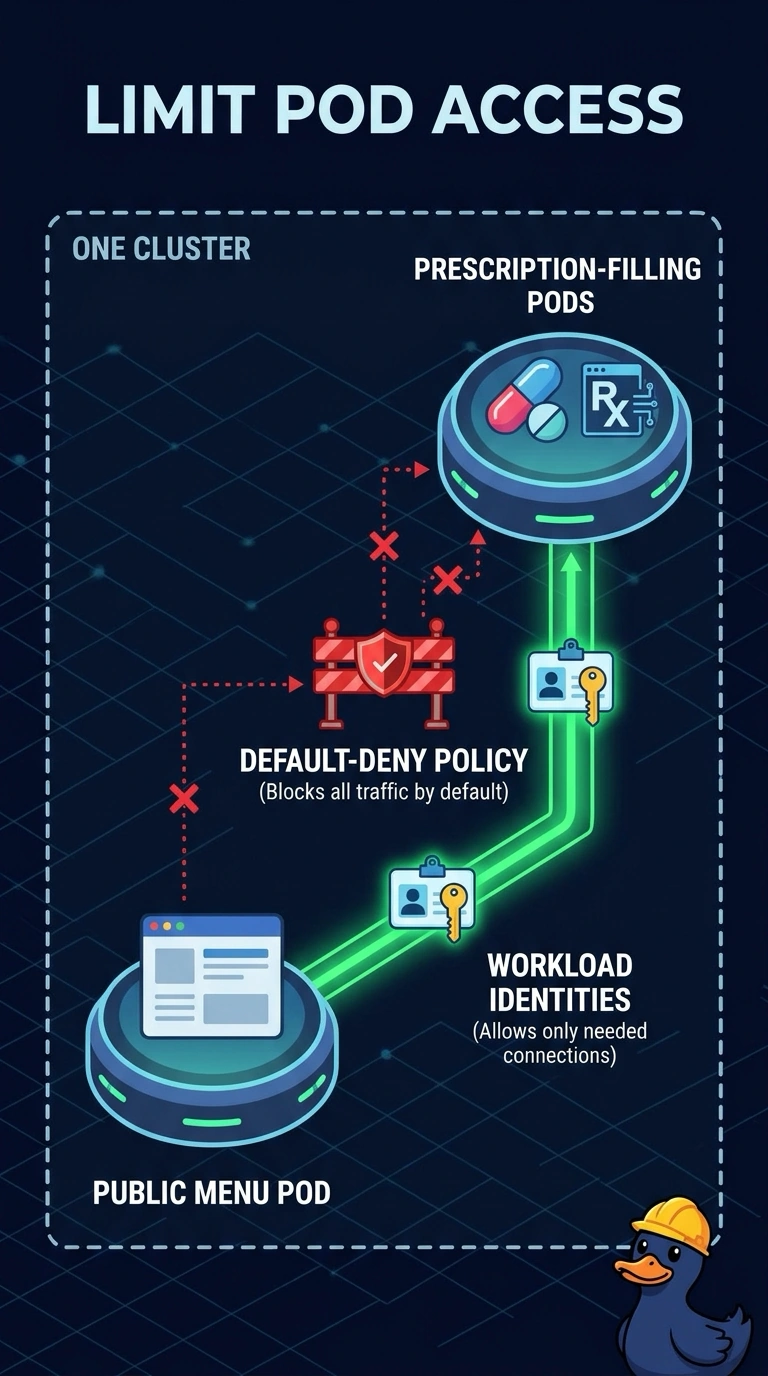
Short Explanation
Rooms in one building still need their own locks. You default-deny the pod network and you allow only the identities that must talk. A perimeter firewall, a worker security group, or a shared password does not separate the menu from the filling line.
Full Explanation
Reachability inside the cluster is flat, so the menu pod can open a path to prescription filling even though nothing in front of the cluster will ever see that packet. Default deny, with allows written for workload identity, limits each service to the peers it must call. A worker-wide security group is too coarse on a shared node, and a shared password does not segment anything. A default-deny policy that allows only the workload identities each service must call is the design that meets this requirement. A perimeter firewall in front of the cluster, where pod-to-pod traffic is not visible is the wrong fit because pod-to-pod packets stay on the cluster network, so a perimeter firewall in front of the building does not see them. A virtual-machine security group on the worker, applied to every pod on that node is the wrong fit because a security group on the worker cannot tell the menu pod from the filling pod when both share the node. A single shared password used by the menu pod and the prescription-filling pod is the wrong fit because a shared password is only a common secret, not a rule for which workload may open a connection. Exam caveat: Identity in the policy has to be the identity the cluster actually enforces, or a label nobody attaches will look strict and permit everything. Operational check: From a menu-pod shell in a lab cluster, confirm a connection to the filling service fails, and from the filling identity confirm only its allowed peer succeeds.