
A game studio runs development pods and the live wallet service on one cluster. Development pods are rescheduled often and must not call the wallet. Which segmentation fits?
Select an answer to reveal the explanation.
Short Explanation
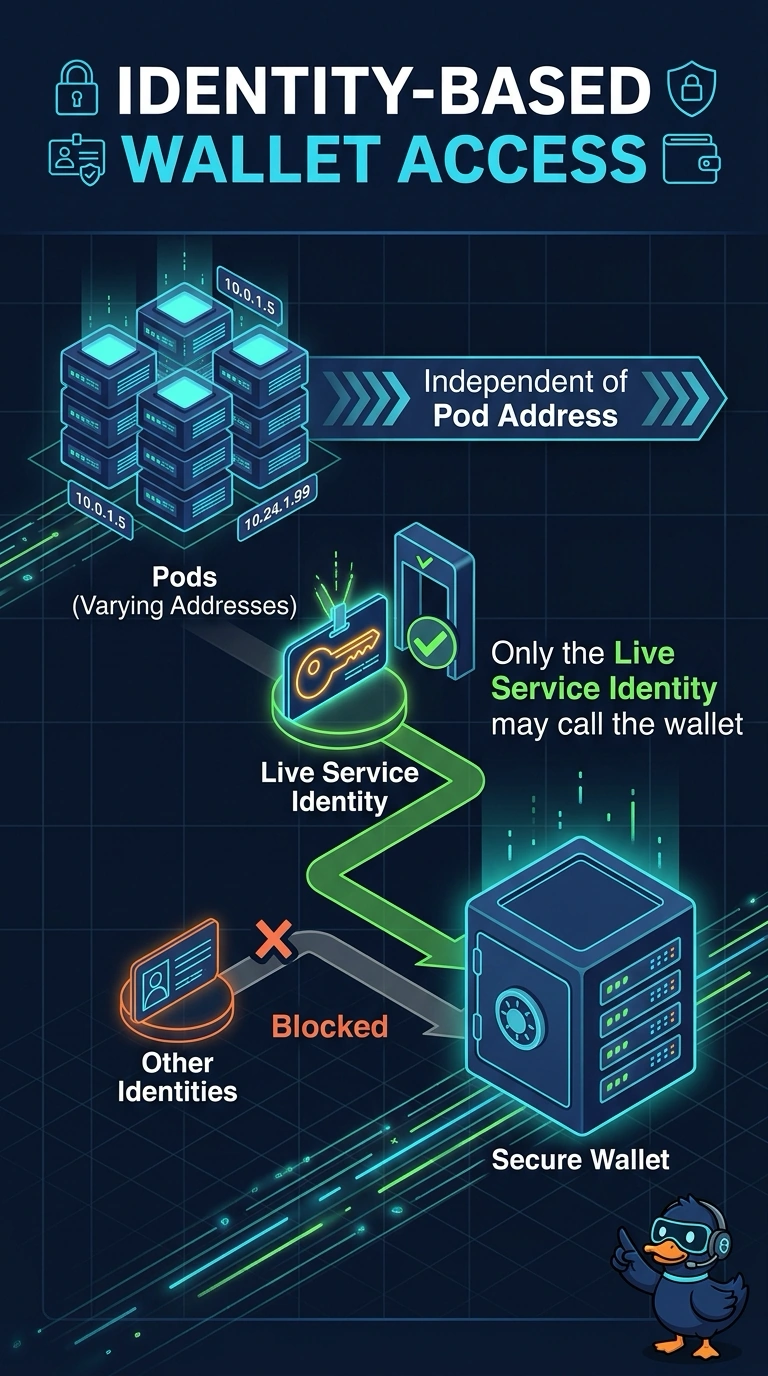
A name badge still works when someone changes desks, and a desk number does not. You allow the live service identity to call the wallet and you refuse everyone else. A static address list, a perimeter firewall, or a node-wide allow will not survive the next reschedule.
Full Explanation
The wallet must accept the live service and refuse development pods, and those pods do not keep stable addresses when they are rescheduled. A policy tied to service identity still matches after a move, which an address list will not, and the perimeter does not see that call. Opening the whole node opens the wallet to whatever development pod lands on that worker. A policy that allows only the live service identity to call the wallet, regardless of pod address is the design that meets this requirement. A static address list of today's development pods, rewritten every time those pods move is the wrong fit because pod addresses change on reschedule, so a list of today's addresses is already wrong after the next move. A perimeter firewall outside the cluster that cannot see calls that stay inside the cluster is the wrong fit because calls from a development pod to the wallet stay on the cluster network, where the perimeter firewall does not look. A node-wide allow that opens the wallet to every pod scheduled on the worker is the wrong fit because a node-wide allow treats every pod on the worker as trusted and lets a development pod reach the wallet. Exam caveat: The identity in the allow has to be the identity the mesh or the network policy enforces, because a label the wallet does not check is only a comment. Operational check: Reschedule a development pod onto a new address in a lab cluster and confirm it still cannot reach the wallet, while the live service identity on a new address still can.