
A logistics insurer already limits its fraud-model file to the scoring service, yet partners can send unlimited queries and reconstruct the decision behavior. Which design addresses that exposure?
Select an answer to reveal the explanation.
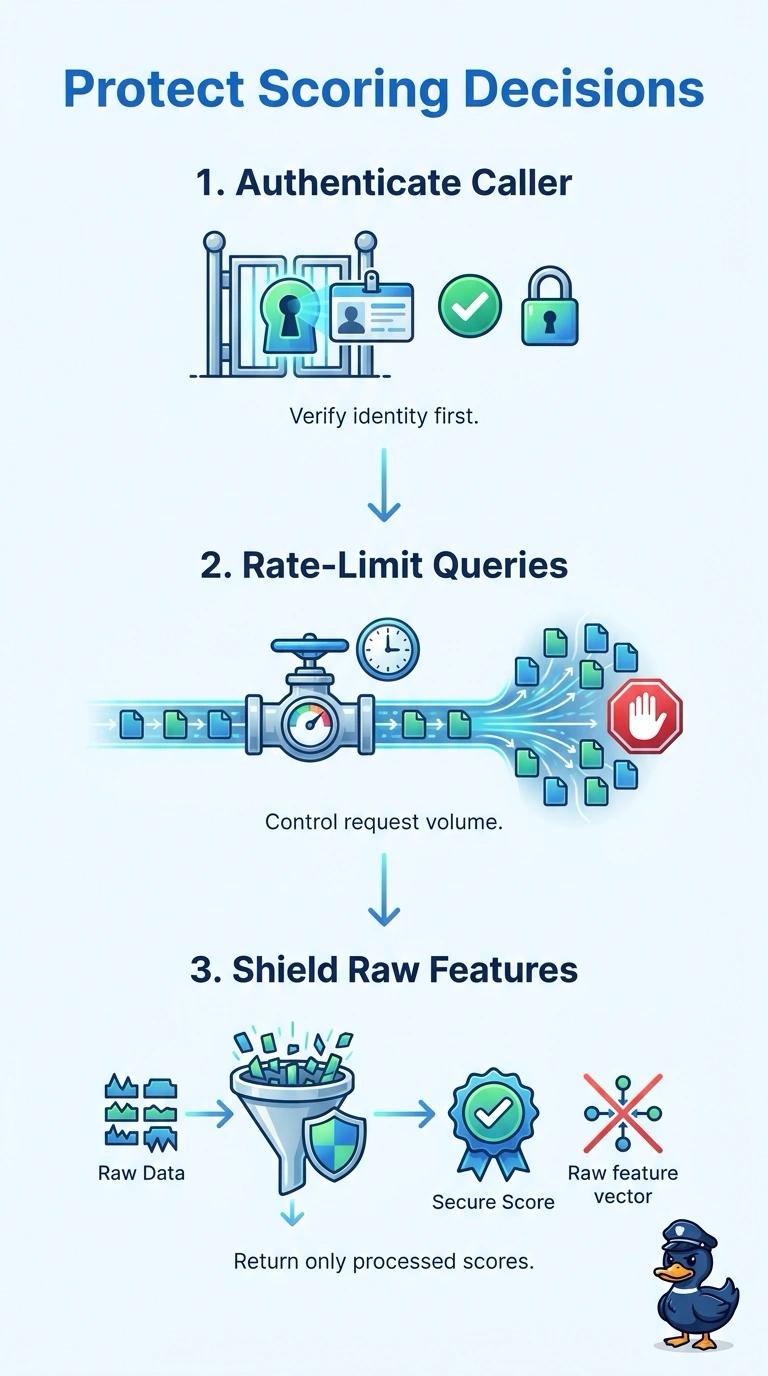
Short Explanation
Guests who may ask the chef a million questions will eventually copy the menu. You authenticate callers, you limit how often they can score, and you stop handing back raw feature vectors. Training-store encryption, a chatbot contract, or archive agility guards a different kitchen.
Full Explanation
The model file is already restricted, and the remaining leak is the scoring interface. Repeated API queries can approximate a model even when they return only predictions. Authentication, query limits, and minimizing output detail reduce exposure. Training-store encryption, a chatbot contract, and archive agility do not change this query path. Authenticate each caller, rate-limit scoring queries, and stop returning raw feature vectors is the design that meets this requirement. Encrypt the training rows at rest, a control this insurer already has on the training store is the wrong fit because the training store is already encrypted, and partners are extracting behavior through the scoring API rather than that store. A no-training contract with a public chatbot the scoring path does not use is the wrong fit because a chatbot contract does not limit how many scoring queries a partner can submit to this API. Crypto agility for claim archives that are not the system partners are querying is the wrong fit because archive agility protects stored claims from a future cipher break and does not throttle the scoring API. Exam caveat: A tight scoring API can still leak if a partner account is shared by dozens of scripts, so the caller identity has to be one partner system and not a shared key posted in chat. Operational check: In a lab, send a burst of scoring calls above the limit and confirm they are refused, and confirm a normal call returns a decision without the raw feature vector.