
A podcast company's cluster starts utility pods as the default service account and mounts the platform API token into those pods. Which control stops that pattern?
Select an answer to reveal the explanation.
Short Explanation
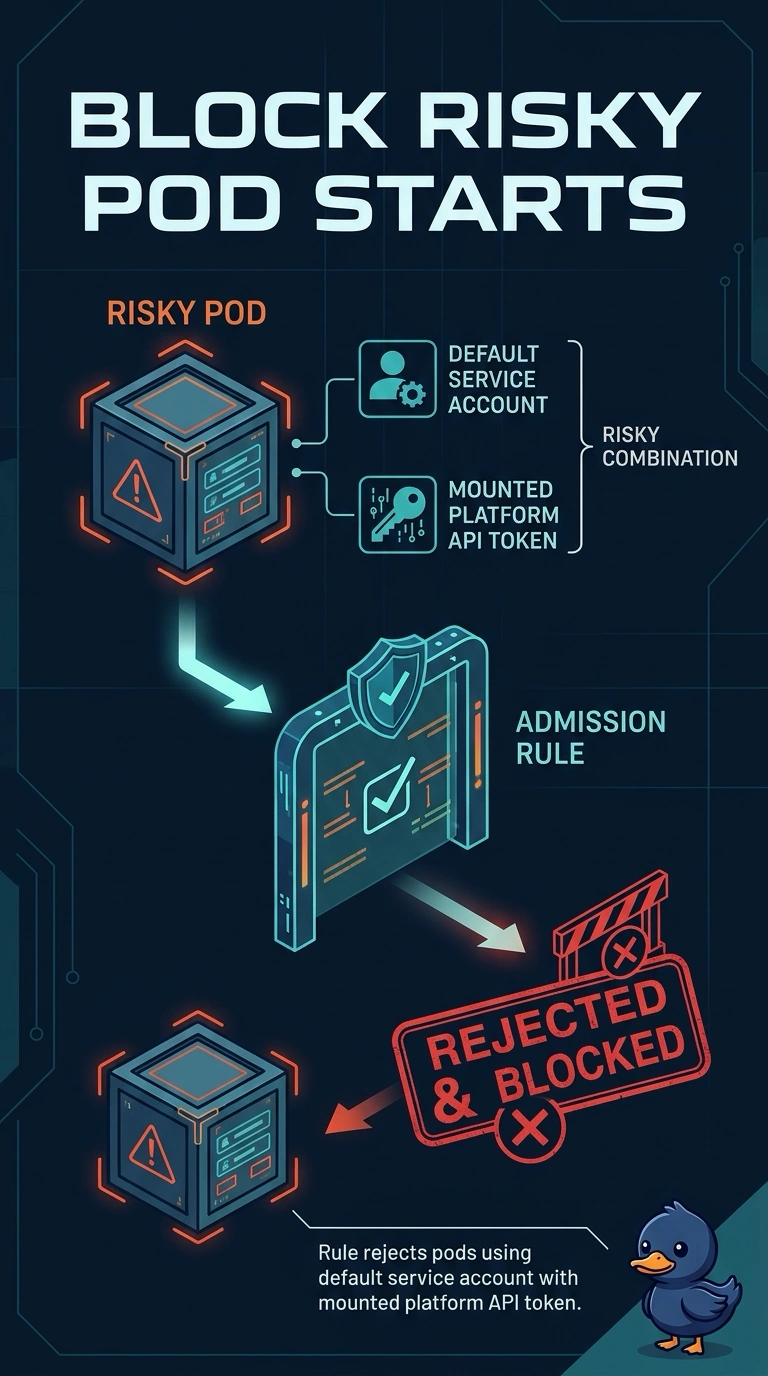
You can think of the mounted token as a spare master key left in every closet: locking a gate does not remove it. Rejecting pods that use the default service account with the platform API token mounted stops that pattern; a perimeter firewall, a node security group, or mutual TLS among application pods leaves the token in place.
Full Explanation
The mounted platform API token authenticates as the pod’s service account, and authorization policy determines that account’s permissions. An admission rule that rejects pods using the default service account with the token mounted prevents the risky configuration from starting, so it directly meets the requirement. A perimeter firewall on a path the pod’s calls to the cluster API do not need to cross is the wrong fit: those calls do not cross that path, and the token is already inside the pod. A node security group that still lets the pod start with the default token mounted is also the wrong fit: it does not strip the token from the pod or change the account it represents. Mutual TLS among application pods that leaves the mounted default token in place is the wrong fit because it authenticates application traffic but does not change which account token the pod holds. Exam caveat: the admission rule must allow a deliberately named service account that utility pods genuinely need, or operators may bypass the rule during an outage. Practical check: submit a lab pod using the default account with the token mounted and confirm admission rejects it, then confirm a pod using a named account without that mount starts.