
A parcel carrier's services already authenticate each other with mutual TLS. Any authenticated service, including analytics, can still call the refund service. Which design limits those calls?
Select an answer to reveal the explanation.
Short Explanation
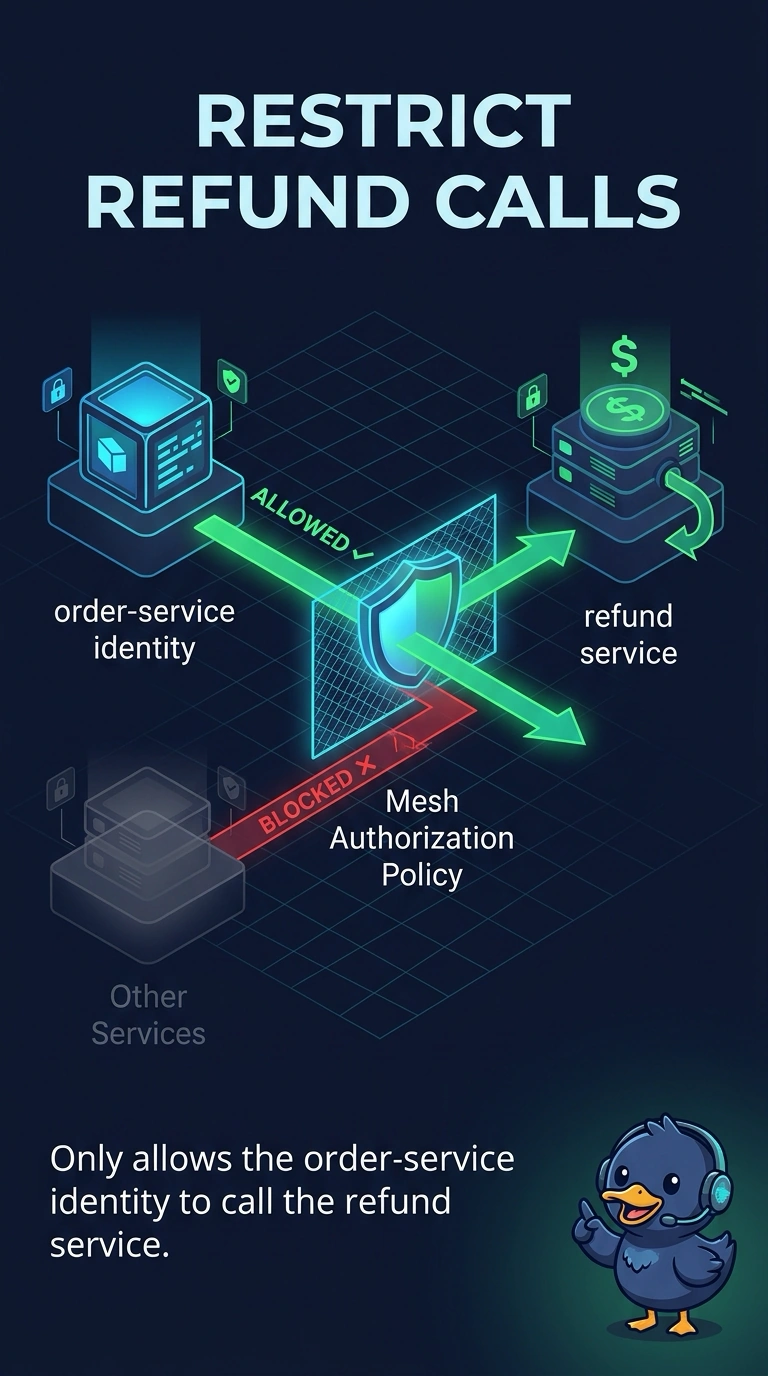
The services already show their badges, and the refund desk still lets everyone in. You allow only the order-service identity in a mesh authorization policy. An edge firewall, a virtual-machine security group, or a shared password does not express that allow.
Full Explanation
Authentication already proves which service is calling, and the hole is authorization because every authenticated identity may still call refunds. A mesh policy that allows only the order-service identity closes that hole without removing mutual TLS. An edge firewall does not see the calls, a virtual-machine group has no guest interface to attach to, and a shared password erases the identity the policy needs. A mesh authorization policy that allows only the order-service identity to call the refund service is the design that meets this requirement. A perimeter firewall at the carrier edge that does not see calls between services inside the mesh is the wrong fit because calls between mesh services stay inside the cluster, so an edge firewall never matches them. A virtual-machine security group on a guest interface these pod services do not have is the wrong fit because these services run as pods without a guest interface a virtual-machine security group can attach to. A shared service password on a flat network in place of the mutual TLS already in use is the wrong fit because replacing mutual TLS with a shared password removes identity and still does not say which service may call refunds. Exam caveat: The policy has to name the identity the mesh actually presents, or a renamed service fails closed for orders while a leftover allow leaves analytics able to call refunds. Operational check: Call the refund service as the order identity and confirm success, then call it as the analytics identity and confirm the mesh denies that call.