
A hosting firm runs two customers' pods on the same node. The pods share the node network, and a firewall at the data-center edge never sees pod-to-pod packets. Which design stops one customer's pod from reaching the other?
Select an answer to reveal the explanation.
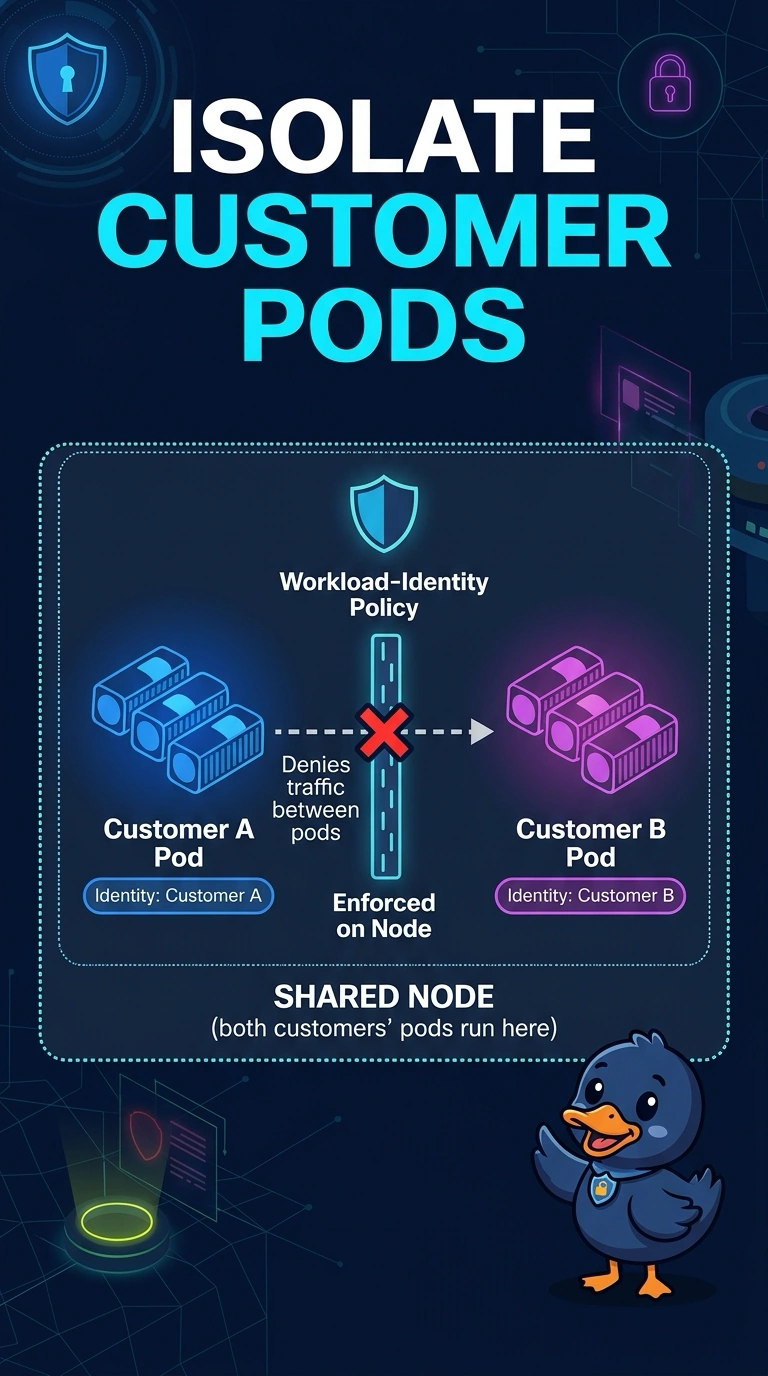
Short Explanation
Two tenants on one floor still need a lock between the rooms. You deny cross-customer traffic on the node by workload identity. The edge firewall, a shared NIC group, or a virtual-machine rule never sees two separate rooms.
Full Explanation
Same-node traffic does not reach the data-center edge, and these pods are not virtual machines with their own interfaces to filter. The deny has to happen on the node, using workload identity, so one customer's pod is not a peer of the other's. A shared NIC group cannot tell the pods apart, and a guest rule has nothing to attach to on this cluster of pods. A workload-identity policy on the node that denies traffic between the two customers' pods is the design that meets this requirement. The data-center edge firewall for packets that remain on the node between the pods is the wrong fit because packets between the two pods never leave the node, so the edge firewall has no chance to deny them. A security group on the one node NIC that both customers' pods share together is the wrong fit because a group on the shared NIC applies to both customers at once and cannot tell one pod from the other. A virtual-machine rule for a guest operating system these pods do not have is the wrong fit because a virtual-machine rule needs a guest these pods do not run, so there is nothing to attach it to. Exam caveat: If the contract promises separate nodes, same-node identity policy is the wrong offer and does not replace the higher isolation boundary the customer was sold. Operational check: From a pod of customer A in a lab cluster, attempt a connection to a pod of customer B on the same node and confirm the node policy denies it.