
A game studio's matchmaker and wallet services already encrypt calls with mutual TLS, and any mesh identity can still invoke the wallet. Which segmentation limits who may call the wallet?
Select an answer to reveal the explanation.
Short Explanation
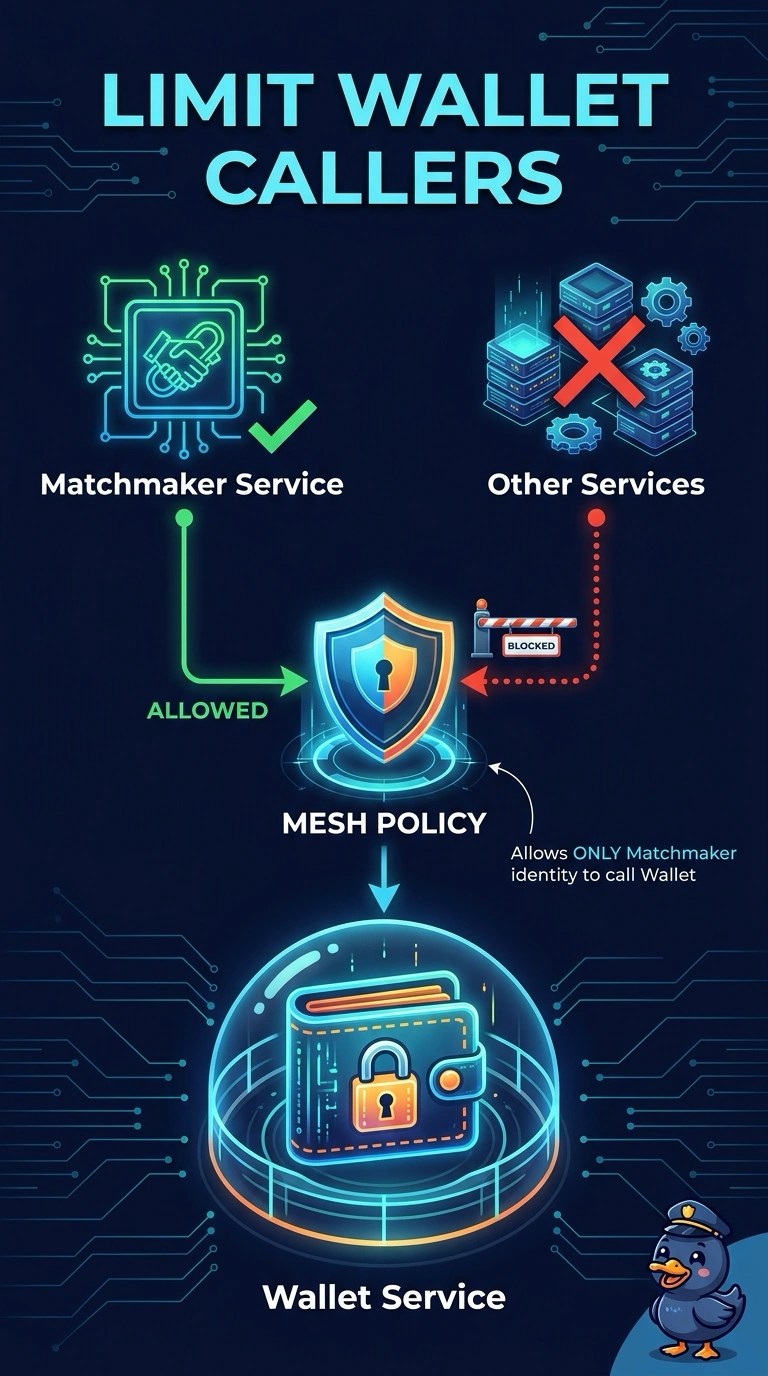
A locked tunnel still lets anyone inside the tunnel knock on the wallet. You allow only the matchmaker identity to make that call. A perimeter firewall, a virtual-machine group, or a shared cluster password cannot name that caller.
Full Explanation
Encryption between the services is already in place, and it does not say who is allowed to call. A mesh policy can name the matchmaker identity as the only caller of the wallet and deny every other identity. The perimeter is not on the pod-to-pod path, a virtual-machine group has nothing to bind to, and a shared password erases the identity the decision needs. A mesh policy that allows only the matchmaker service identity to call the wallet is the design that meets this requirement. A perimeter firewall in front of the cluster that does not see calls between these pods is the wrong fit because pod-to-pod calls stay on the nodes, so a perimeter firewall never evaluates the wallet request. A virtual-machine security group on services that have no guest machine to attach is the wrong fit because these services are pods, and a virtual-machine security group does not attach to a workload with no guest network. A single shared cluster password used in place of the service identities is the wrong fit because a shared password removes the service identity the mesh would use to tell the matchmaker from every other caller. Exam caveat: Keep the mesh allow on the same identity the certificate presents, or a renamed caller fails closed or lands in an allow too broad to protect the wallet. Operational check: From a lab service that is not the matchmaker, call the wallet and confirm the mesh denies it, then confirm the matchmaker identity still succeeds.