
An online bookstore runs checkout and billing as services on one cluster. Billing should accept only checkout, even though other pods can route to the billing port. Which design enforces that?
Select an answer to reveal the explanation.
Short Explanation
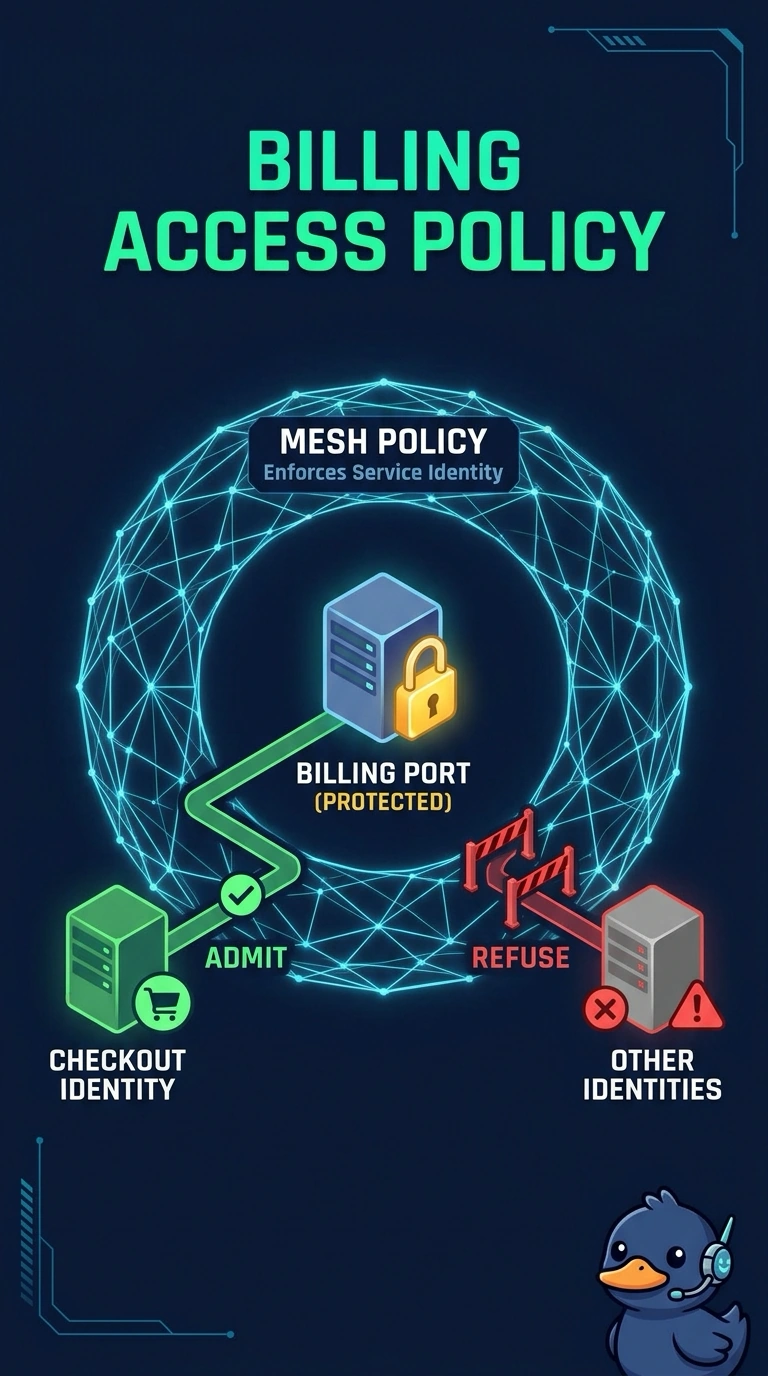
A hallway that reaches every office is not a guest list on the door. You admit only the checkout identity to billing and you refuse every other service identity. A perimeter firewall, a shared password, or a node security group cannot name checkout and deny the rest.
Full Explanation
Routing reachability is not authorization between services. The mesh gives each service an identity and lets billing require the checkout identity on that port, so another pod that can route there is still refused. The perimeter does not see this flow, and neither a shared password nor a node security group can name checkout while denying every other service. A mesh policy that admits the checkout service identity and refuses every other identity on that port is the design that meets this requirement. A perimeter firewall sitting outside the path between pods on the same cluster is the wrong fit because pod-to-pod traffic stays inside the cluster, so the perimeter firewall is not on the path and cannot name the caller. A shared service password that any pod can present once someone copies it is the wrong fit because a shared password grants billing to whoever learns it, with no separate identity for checkout. A security group on the node that treats every pod on that node as the same source is the wrong fit because a node security group cannot tell the checkout pod apart from any other pod on that same node. Exam caveat: Mesh policy does not replace a later grant on the data store, so any table billing reads still needs an identity permission of its own. Operational check: Call billing from the checkout identity and confirm success, then call it from another service identity on the same cluster and confirm the mesh refuses it.