
A transit agency's fare-evasion model is a file of weights that the scoring service loads. Analysts with notebook access have been downloading that file. Which protection fits the model?
Select an answer to reveal the explanation.
Short Explanation
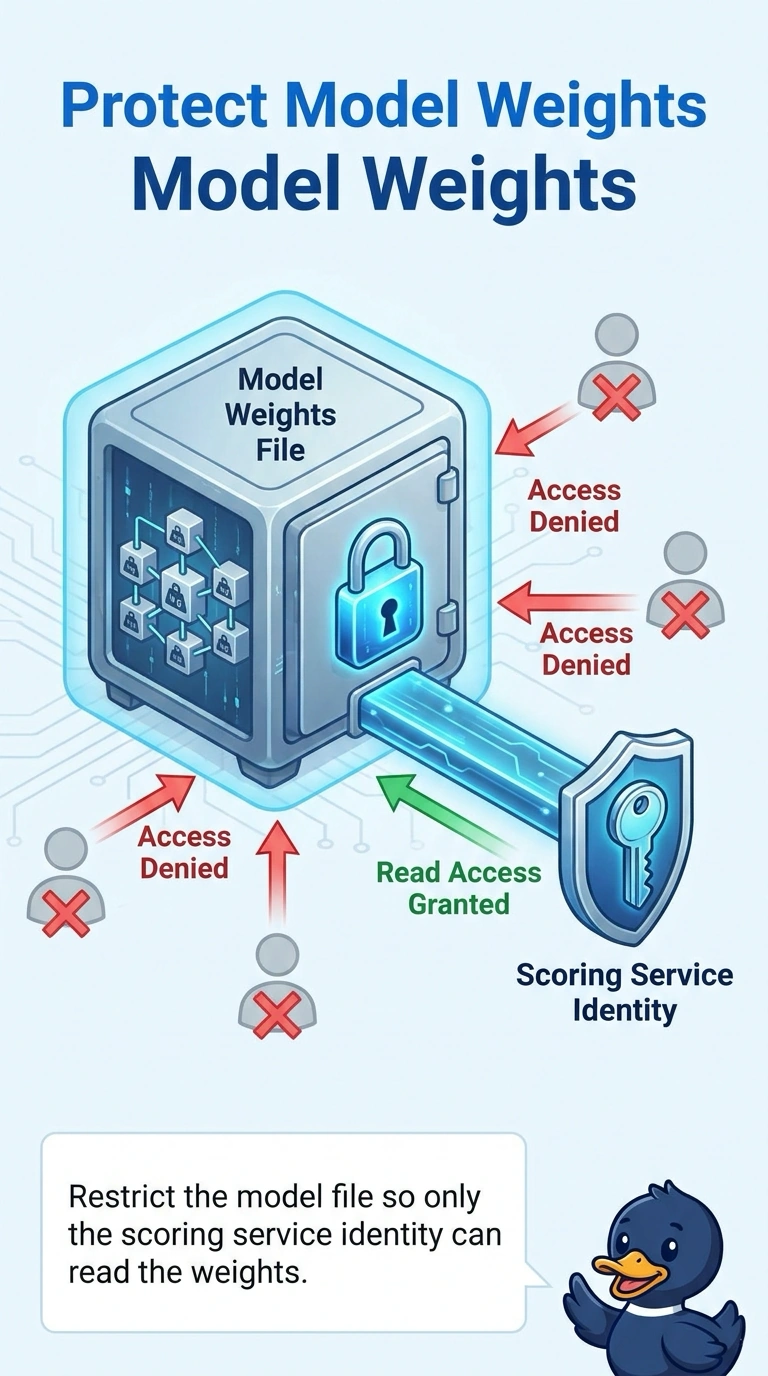
The recipe in the safe is a different asset from the flour in the pantry. You let only the scoring service read the model weights and you stop analyst downloads. A cleaner training set, a chatbot prompt boundary, or crypto agility for archives does not lock this file.
Full Explanation
The weights are the model, and they are an asset separate from the rows used to train them. Letting only the scoring service identity read the file stops analysts from walking off with a working copy. Cleaning a future training set, bounding a chatbot the gates do not use, and planning crypto agility for archives each protect a different asset. Restrict the model file so only the scoring service identity can read the weights is the design that meets this requirement. A cleaner training set aimed at later learning rather than the weights file already built is the wrong fit because training-set care matters before the next training run and leaves the current weights downloadable. A prompt boundary on a public chatbot the fare gates do not consult for scoring is the wrong fit because a chatbot boundary does not apply to a scoring file the fare gates never send to a chatbot. A crypto-agility plan for long-lived archives that are separate from this model file is the wrong fit because crypto agility is about long-lived secrets and archives, not about who can read this model file. Exam caveat: Locking the file does not protect a copy that already left. Check notebook histories for prior downloads and treat a copied file as exposed. Operational check: From an analyst notebook, attempt to read the model file and confirm denial, then confirm the scoring service identity still loads the weights.