
Partner firms upload contracts to a freight broker's file service through a proxy the broker owns, and that proxy terminates the session. Customer account numbers are appearing in the files. Which control can see this flow?
Select an answer to reveal the explanation.
Short Explanation
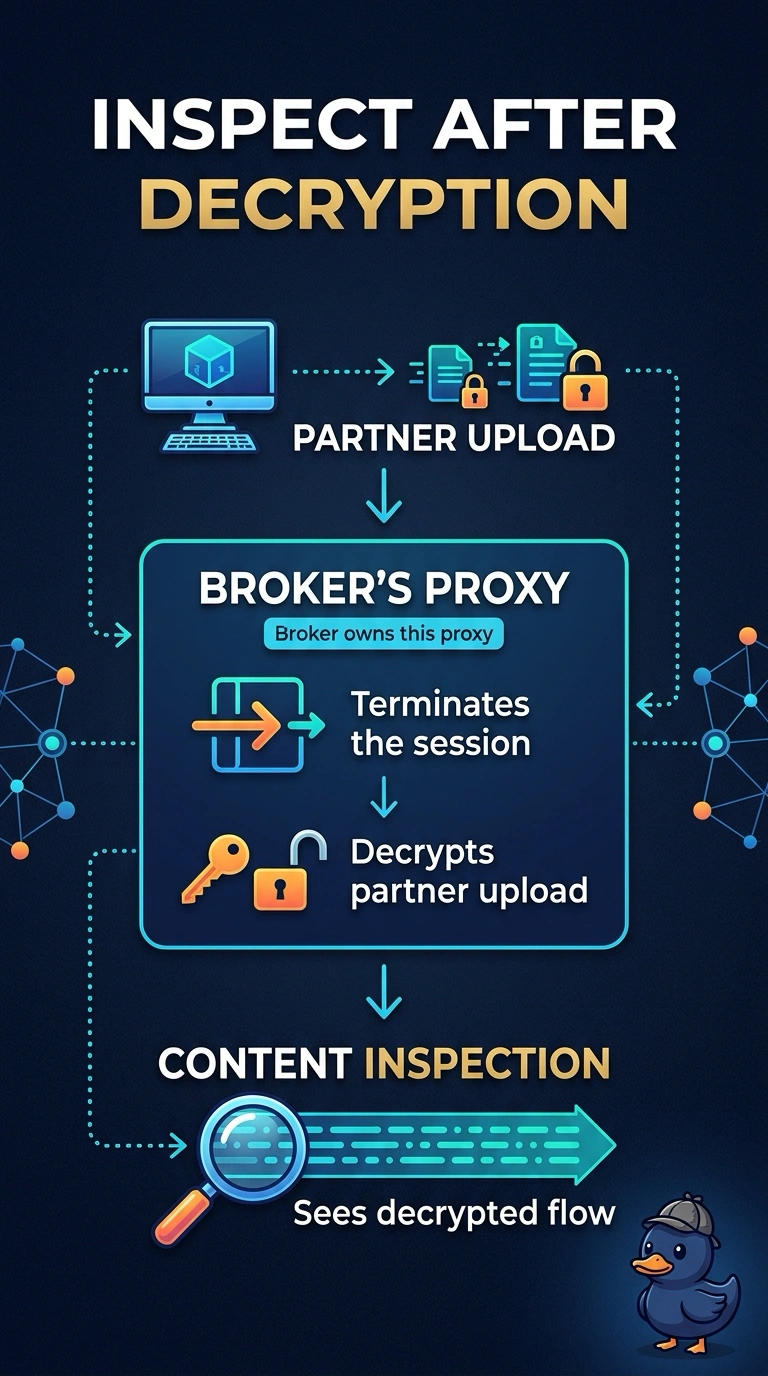
The secret is inside a lock your own proxy already opens. You inspect the contract at that proxy after decryption. A port permit, an agent on a partner laptop, or a mail scanner never reads this upload.
Full Explanation
The account numbers sit inside a session the broker's own proxy already terminates, so the cleartext exists at that proxy and nowhere the broker controls on the partner side. Content inspection there can read the upload and block the sensitive pattern before the file is stored. A port permit, an agent on an unmanaged partner laptop, and a mail scanner are not on the cleartext of this flow. Content inspection on the broker proxy after that proxy decrypts the partner upload is the design that meets this requirement. A permit for the file-service port that leaves the uploaded contract body unread is the wrong fit because a port permit sees the connection and does not parse the contract, so the account number still lands in the file. An endpoint agent on partner laptops the broker does not own or manage is the wrong fit because partner laptops are outside the broker's management, so an agent there is not a control the broker can place. A mail-gateway scan of attachments that sits off this browser upload path is the wrong fit because the contracts arrive as file-service uploads, and a mail scanner is not present on that browser path. Exam caveat: Inspect only the file-service host the broker terminates, since decrypting unrelated partner applications would widen the design past the flow that carries the contracts. Operational check: Upload a lab contract that contains a test account number, confirm the proxy blocks or flags it, and confirm a contract without that pattern still stores.