
A publisher runs payroll and a public website as pods on the same cluster nodes. Website pods must not reach payroll. A security group on the node sees only the node interface. Which control fits?
Select an answer to reveal the explanation.
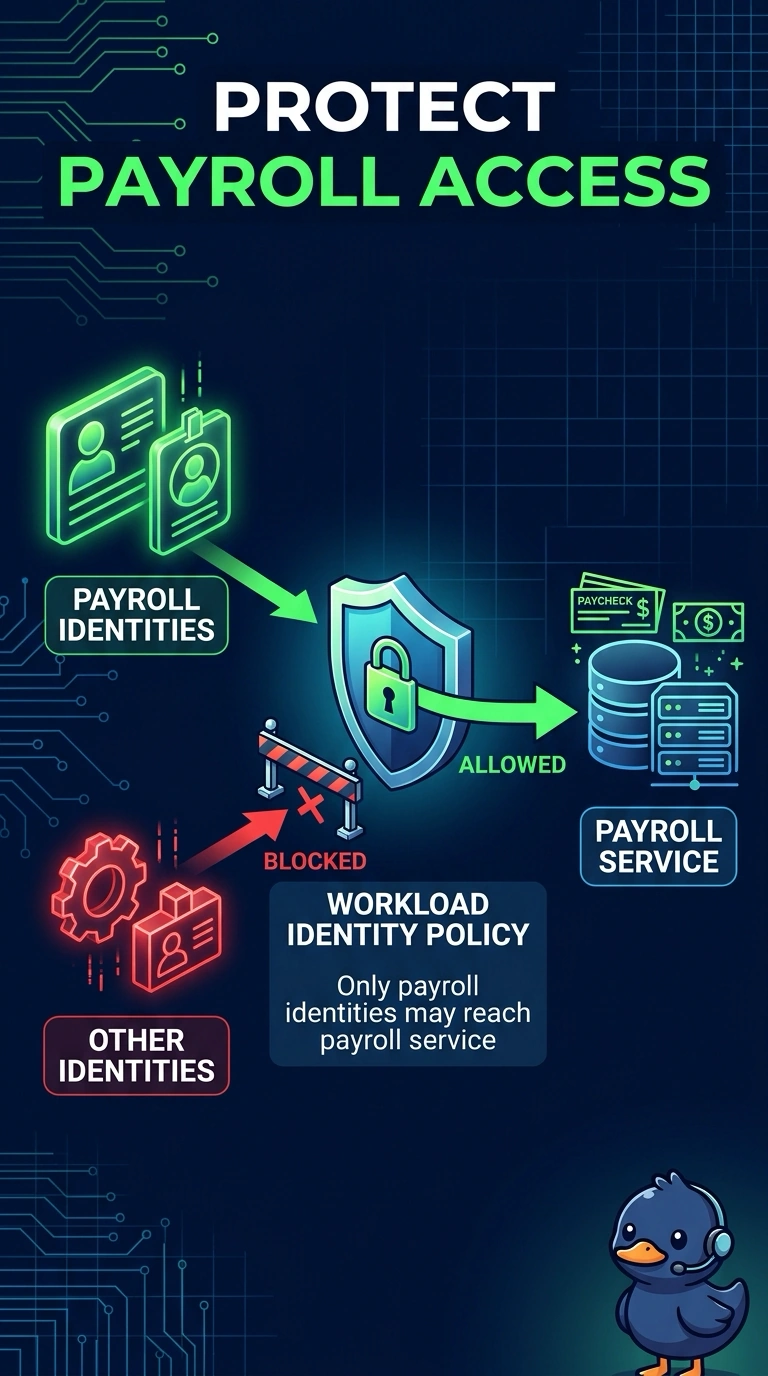
Short Explanation
Two offices on one floor still need a locked door between them. You deny the website identity from reaching payroll even though the pods share nodes. A node security group, a perimeter firewall, or a function rule you have nothing to attach cannot see that door.
Full Explanation
The website and payroll share nodes, so a rule on the node interface cannot name one pod and deny the other. Workload identity can accept only payroll identities, and the website identity is refused even though the packet does not hit the perimeter. A function rule has nothing to attach to, so the enforcement point has to see pod identity rather than only the node. A workload identity policy that lets only payroll identities reach the payroll service is the design that meets this requirement. The node security group, blind to whether a pod is the website or payroll is the wrong fit because pods on one node share that node's interface, so the node security group cannot separate website from payroll. A perimeter firewall that sees traffic entering the cluster and not pod-to-pod sessions is the wrong fit because the perimeter is outside the cluster and does not see a website pod calling payroll inside it. A function security rule for a serverless workload this publisher does not run is the wrong fit because a function rule attaches to a workload the publisher does not run and never sees these pods. Exam caveat: Identity policy inside the cluster does not protect payroll data that a person exports through an approved payroll client. That client path needs its own control. Operational check: From a website pod, attempt the payroll port and confirm refusal, then from a payroll identity confirm the same port succeeds, with no change to the node security group.