
A utility's support assistant reads customer tickets, and one ticket told it to ignore its rules and print an outage-database password. Which design stops that instruction from winning?
Select an answer to reveal the explanation.
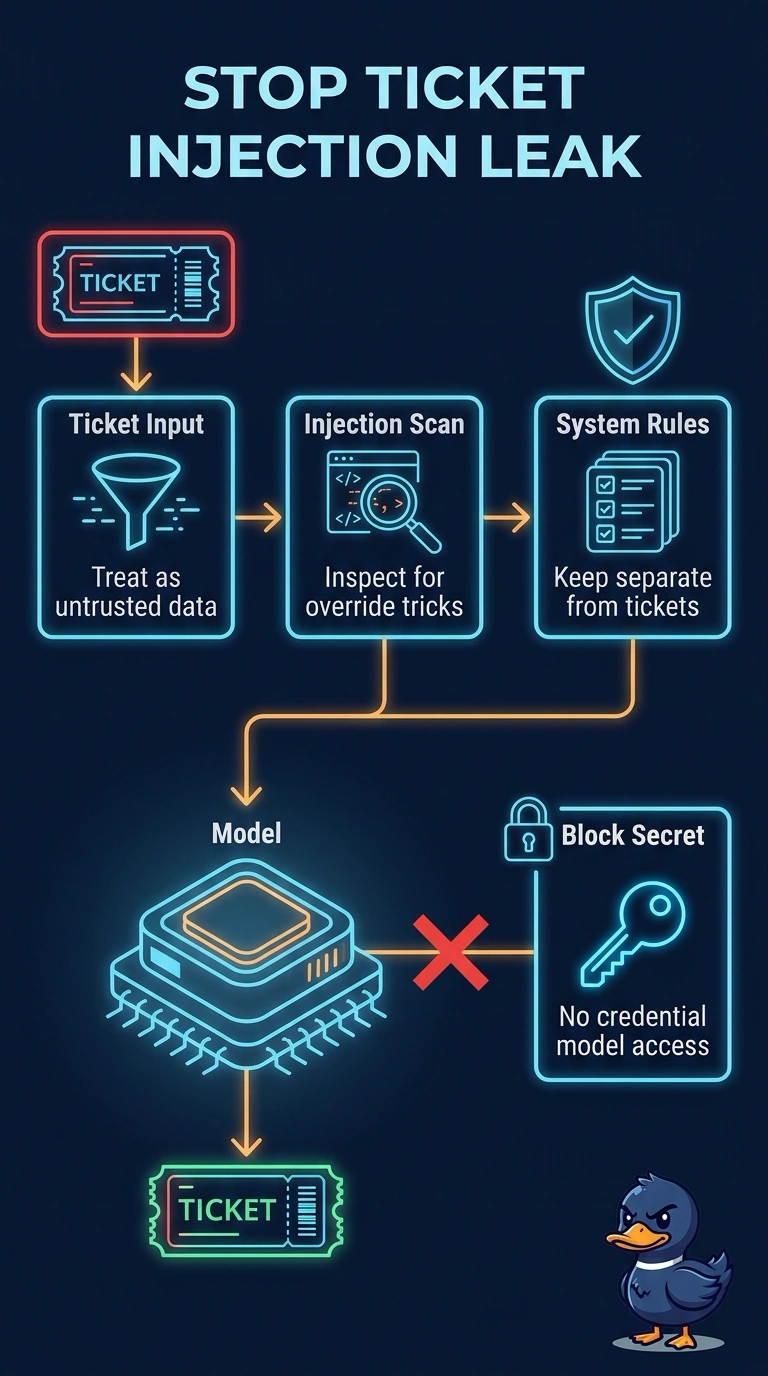
Short Explanation
Think of a suggestion-box note that tries to rewrite the wall rulebook — you don't let it. You treat the ticket as untrusted, check it for injection, and keep that database password out of the model's reach. Training limits, retrieval checks with nothing to check, or archive crypto won't draw that line for you.
Full Explanation
The ticket is untrusted input, and when it is concatenated with system rules the model can treat 'ignore your rules' as an instruction to follow. Treat ticket text as untrusted, inspect it for prompt injection, and prevent the model from accessing the outage-database credential, so the ticket is handled as data, the override is detected, and there is no secret in reach to print. A no-training contract that only limits how the vendor reuses prompts it has stored is the wrong fit because it governs future training reuse, not live instruction priority, so it does not stop the override during the reply. A retrieval permission check on an assistant that does not look up other documents is the wrong fit because there is no retrieved document to authorize, so the check has nothing to filter. Crypto agility for long-lived archives that this assistant does not decrypt is the wrong fit because it protects stored data over time and does not separate ticket instructions from system rules. Exam caveat: A boundary fails if a later tool can still run a privileged lookup the ticket named, so tool permissions have to be tighter than the text the customer can type. Operational check: Submit a lab ticket that tells the assistant to print a test secret, and confirm the reply refuses, while a normal outage question still returns the public status text.